This post contains affiliate links. As an Amazon Associate I earn from qualifying purchases. If you click a link and make a purchase, I may receive a small commission at no extra cost to you.
Key takeaways
- Humboldt Redwoods State Park is one of the darkest places we tested anywhere in California. Our best reading here was 21.45 mag/arcsec².
- Dyerville Bar, a gravel bar right on the river, came in at 21.38 and gives you the more open view.
- Albee Creek Campground, deep in the interior, was the darker of the two at 21.45, but the trees box you in and hide the core. Darkness and openness pull in opposite directions here.
- The sky is the easy part. Fog and cloud are the gamble, so skip the generic forecast and watch the cloud layers on a site like windy.com to find your window.
Introduction
Some of the tallest trees on Earth make a strange stargazing partner. They are the reason you drive out here, and they are also the reason you have to think hard about where you stand once the sun goes down.
We had been on quite the streak in northern California, stargazing at Point Reyes, Redwood National Park and the Lost Coast. Humboldt Redwoods State Park was the next stop. These are places that are often foggy, clouded over or half buried under a marine layer, so every night out here is a bit of a gamble.
The way I play that gamble is with the clouds, not the generic forecast. A site like windy.com lets you watch the cloud layers closely, and if you keep an eye on them you can find windows, at certain times of year, where the sky has a real chance of being clear.
More than once on this trip we showed up under thick cloud and watched it clear out. Trust the process a little and you can find open skies. Our base was in Eureka, only about 45 minutes to an hour away, and in the end we tested two sites in one night: a gravel bar on the river and a campground deeper in the forest.

Want to experience the awe and beauty of being under a truly dark sky?
Get expert help putting together a life-changing night under the stars: the ultimate astro vacation.
Plan my tripTesting Humboldt Redwoods State Park stargazing sites for light pollution
Dyerville Bar
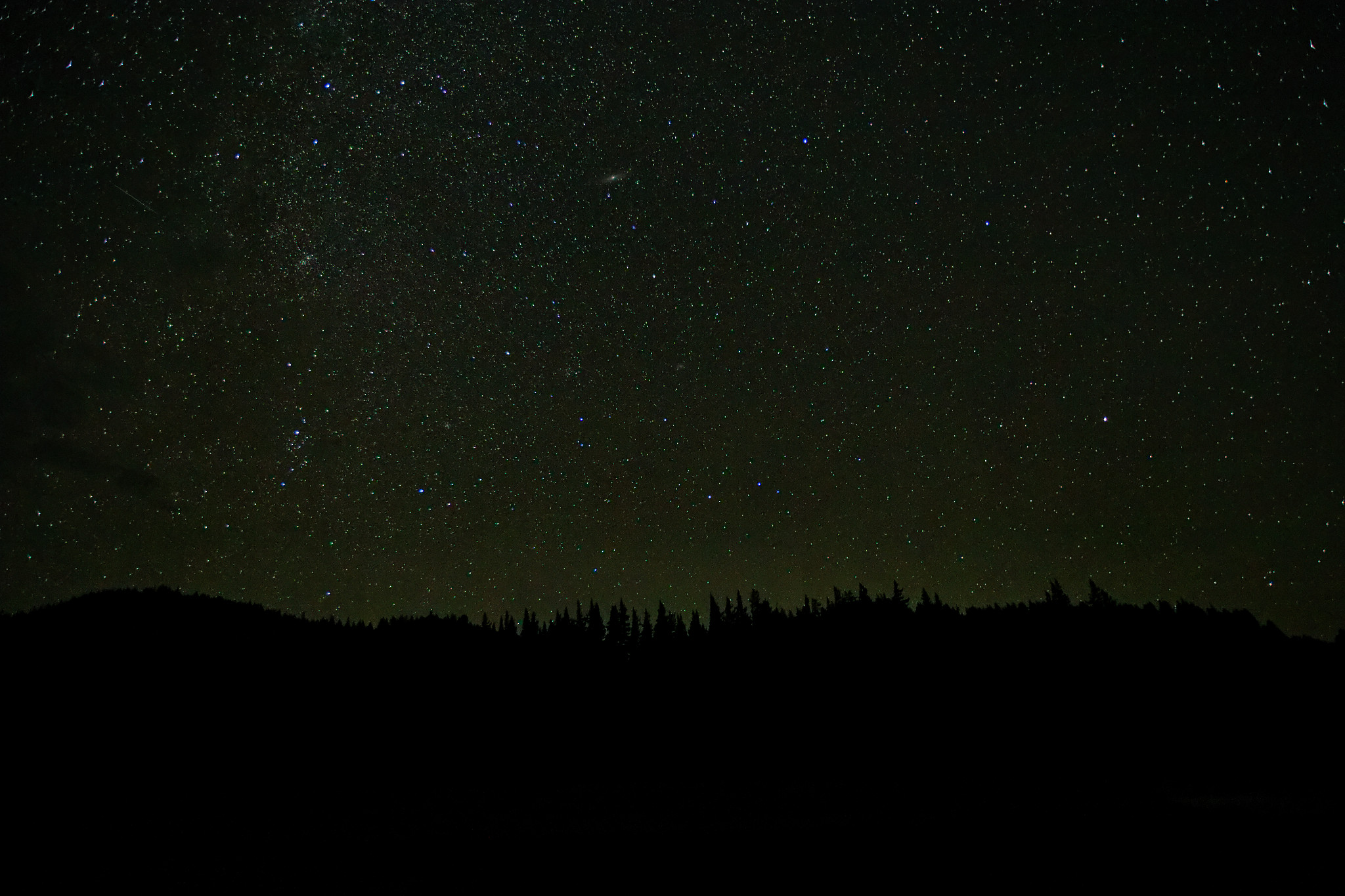
Clear on our night, moon already set, with a possible light dome beyond the trees. Metered from the gravel bar beside the river.
After a day among some of the oldest and tallest trees in the world, we made our way to Dyerville Bar, a gravel bar right on the river. There is a nice little bridge, and the spot sits below one of the overlooks, so you can drive right down to it. You may want four-wheel drive, or at least a lot of trust in your vehicle. It is remote, it is a beautiful place to watch the sunset, and it sits away from most of the traffic that moves through the park.

To kill time before dark I put on a little of Murder Mountain, the docuseries about the startling number of people who have gone missing in Humboldt County, tied closely to the marijuana industry back when it was still illegal, more than a decade ago. Maybe not the best pick right before wandering the woods in the dead of night….
Things have changed since then, so I do not think there is much to worry about today, but it slightly spooked me, and it got me thinking about how proud people out here are of being remote and getting away from society.
Then the sun went down, the moon followed it, and it was time to get to work. Before the first reading I guessed we would land around 21.3 or 21.4, and I did not expect it to be quite as dark as Redwood National Park. The meter read 21.38.
On paper that number lands just inside Bortle 3 territory, but I am calling this one pretty much a Bortle 2. The Milky Way had good structure to it, I could easily pick out all seven stars of Ursa Minor, the Little Dipper, and Andromeda was easy to spot and looked great through binoculars. The tree line did cover a bit of the horizon where the Milky Way core was sitting, and we still came away with some fantastic shots.

It is a beautiful, remote place to stargaze, and the river gives you a wider slice of sky than you will find once you are under the canopy. Still, I wanted to see if we could find something darker, so we headed deeper into the park.
Albee Creek Campground (adjacent lot)
Clear on our night, moon already set. Metered next to the campground, with the tree line blocking the Milky Way core.
From the river we took a narrow road through the redwoods and deep into the forest, then set up right next to Albee Creek Campground in the interior of the park. I know astronomy events are held in this park and near this campground, and after standing here it is easy to see why.
The reading came back 21.45, a solid number and a little darker than down by the river. It is another on-paper Bortle 3 that I am calling a 2, for the same reason as Dyerville: there was a good amount of detail in the Milky Way, even with the core hidden behind the tree line.
Down under the trees it is insanely dark. You cannot see your hand in front of your face, so plan where you will set up before the light fades, because otherwise the trees will decide for you and your view will be obstructed.
That is the trade-off worth knowing before you come. The meter reads a patch of sky straight overhead, but you only get to look at the part of the sky the trees leave you. Albee Creek wins on darkness, and Dyerville Bar wins on openness. If you want the darkest sky overhead, go deep. If you want a wider view for a camera, stay by the river.
Against Redwood National Park, the skies here were not quite as dark. You are splitting hairs, since my best reading up there was 21.55 at Redwood Creek Overlook and my best here was 21.45, but I did notice the difference. I also found it a lot easier to find open overlooks at Redwood National Park, so there is simply more to choose from.

Final word
Humboldt Redwoods is one of the darkest places we tested in all of California. Redwood National Park edges it out on the meter and on the number of open overlooks, but you are still talking about extremely dark skies here, and I really enjoyed being posted up on the river. It is a gorgeous park in the daytime too. The Avenue of the Giants is absolutely worth a drive, and the little groves are lovely to stroll through before dark.
The biggest variable is not the light, it is the weather. Fog and cloud decide whether you get a night at all, so monitor them closely and be patient with your window. The second is being comfortable with the remoteness, because this is a unique corner of the country. If you can do both, you will have an amazing stargazing experience. The sky was never the hard part. Knowing when and where to show up was.
Find the dark sky nearest you
Knowing when and where to show up is the skill that travels. Whether you live near the redwoods or a few hours from the nearest city, there is a darker sky within reach of you, and the same habits find it: read the cloud layers instead of the generic forecast, and pick your spot before the light fades. I put together a free guide that walks you through finding dark skies near you. Grab the guide here.
Leave a Reply