This post contains affiliate links. As an Amazon Associate I earn from qualifying purchases. If you click a link and make a purchase, I may receive a small commission at no extra cost to you.
Key takeaways
- The park with the tallest trees on Earth also has about as dark a night sky as California offers. Our best reading here was 21.55 mag/arcsec², darker than Lassen and darker than the Lost Coast.
- Klamath River Overlook is the easy win: a parking lot right at the viewpoint, 600 feet (180 m) above the Pacific, a sunset worth showing up early for, and 21.39 after dark.
- Big Tree Trailhead, in the interior of the park, came in at 21.44. The parking lot opens a real hole in the canopy, so you get a good portion of the Milky Way without walking anywhere.
- Redwood Creek Overlook was the darkest of the night at 21.55, wide open, and high enough on Bald Hills Road that you can sometimes climb above the coastal fog. Fog and clouds are the whole game out here, so watch the forecast.
New to the numbers? The Bortle scale runs from 1, the darkest skies left on Earth, to 9, an inner city where the constellations disappear. Sky brightness is measured in mag/arcsec², where a higher number means a darker sky. A Bortle 2 is a truly dark sky, dark enough that your surroundings show only as silhouettes against the sky.
Introduction
Redwood National and State Parks sounds like a hard place to stargaze. The tallest trees in the world are wonderful company, but they are also a 300 foot wall between you and the sky. The thing is, this stretch of far northern California also has some of the darkest skies in the state, so we were not about to pass up the chance to find out what was above the canopy.
Before the first reading, I guessed we would land around 21.3, maybe 21.4, and told myself that if we got really lucky we might do better than that. We spent the afternoon among the redwoods, then chased the sky in three stops: a coastal overlook, a parking lot deep in the interior, and one more overlook up in the hills. Each one was darker than the last, and the third one ended up being the darkest sky I have measured in California.

Want to experience the awe and beauty of being under a truly dark sky?
Get expert help putting together a life-changing night under the stars: the ultimate astro vacation.
Plan my tripTesting Redwood National and State Parks stargazing sites for light pollution
Klamath River Overlook
Clear on our night, a small light dome low to the east. Metered from the overlook with the Pacific to the west.
This one is almost too easy. The parking lot sits right at the viewpoint, 600 feet (180 m) above where the Klamath River meets the Pacific, so you step out of the car and you are there. No hike, no scramble, no headlamp fumbling down a trail. It is worth visiting in daylight purely for the scenery, and the sunset from up here is dreamy.
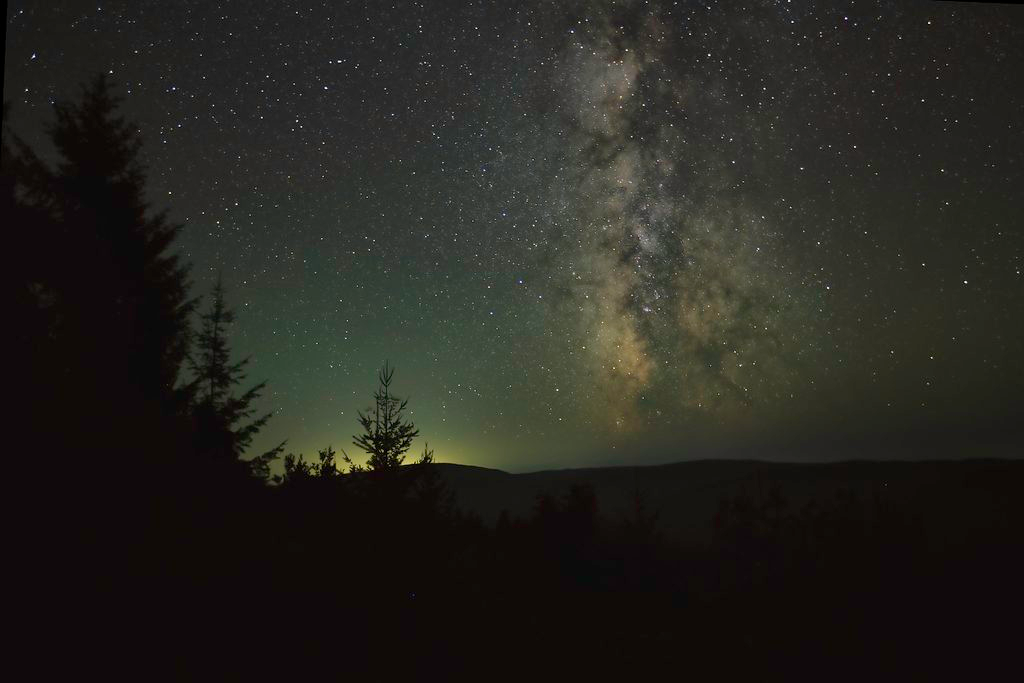
Once it got dark, the meter read 21.39. On paper that number sits in Bortle 3 territory, but I am calling it a 2, and the sky earned it. The Milky Way was popping, with real structure to it, and the only blemish was a small light dome off to the east on our night. That is the kind of thing that shifts with humidity and haze, so do not assume it will look the same on your visit.
The catch here is the one that follows you all along this coast: you are right on the ocean, and this area can fog in or cloud over fast. Watch the forecast and time your visit around it. When it does line up, this is one of the most convenient dark sky viewpoints I have stood at anywhere.

Big Tree Wayside
Clear, no cloud overhead. Metered from the parking area through the gap the lot opens in the canopy.
From the coast we hopped in the Jeep and drove about 30 minutes south into the interior of the park, to the Big Tree parking area. This is the trade the redwoods make you: the trees take a chunk of your sky, but the parking lot cuts a gap in the canopy that is big enough to work with. You can still see a good portion of the Milky Way straight up, and you can park, get out, set up a camera, and take it in without walking anywhere.
The meter came back at 21.44, a touch darker than the coast, and it felt darker too. The Milky Way had more pop to it.
Here is the funny thing about a sky like this: the constellations actually get harder to find. Most people grow up seeing a few hundred stars, so the patterns stand out. Out here you are looking at thousands, and the shapes you know get buried in everything around them. That is a good problem to have.
Traffic through this part of the park was almost nonexistent while we were out, so no headlights wrecking our dark adaptation. Worth noting that we were there on a weeknight, which is the easy mode version of this. A summer weekend will not be as quiet.

Redwood Creek Overlook
Clear and wide open, with a light dome low at the base of the Milky Way on our night. Metered from the overlook facing the open view.
I had a feeling there was something darker still out there, so we made one more stop at Redwood Creek Overlook, up on Bald Hills Road in the heart of the park.
It is another drive-up spot, and the view opens wide, which is exactly what you want after standing under a canopy all evening. Being up in the hills has a second benefit on this coast: when the marine layer rolls in below you, you can sometimes be sitting above it.
The reading was 21.55. I honestly did not expect this to beat Big Tree based on the satellite data, so that was a happy surprise. It is the darkest number I have logged in California so far, ahead of Lassen and ahead of the Lost Coast, which had been my benchmark for a wide open coastal sky.
The one drawback on our night was a light dome sitting low, right at the base of the Milky Way. Look straight ahead instead and it was spectacular: the star clouds of Cygnus were blazing overhead, and the dust lane running through them was properly dark. That contrast, bright clouds against black lanes, is the thing you cannot fake with a camera at a mediocre site. It is either there or it is not, and here it was there.

Final word
Stargazing at Redwood is all about the weather. Clouds and fog are the deciding factor, and the questions you are really asking are whether you can move inland to get out from under the marine layer, or climb high enough to get above it. That is why having three very different spots matters here: a coastal overlook, an interior parking lot, and a hilltop viewpoint give you options when one of them is socked in.
If you can swing it, it is fantastic. There are so many wide open overlooks and meadows in this park that the tall trees stop being an obstacle and start being the thing you are standing among while the Milky Way comes up. Add in a full day of exploring the groves before dark, and you get one of the best day-into-night combinations in California. It was magical being out there, and I did not expect to walk away with my darkest reading in the state.
Find a sky like this near you
The lesson from this night is that dark skies hide in places you would write off. Nobody puts the world’s tallest forest on a stargazing list, and it turned out to hold the darkest sky I have measured in California. There is probably something similar closer to you than you think, and the trick is knowing how to spot it and how to read the weather that will make or break the night. I put together a free guide that walks you through finding dark skies near you. Grab the guide here.