This post contains affiliate links. As an Amazon Associate I earn from qualifying purchases. If you click a link and make a purchase, I may receive a small commission at no extra cost to you.
Key takeaways
- Stars in a constellation look like neighbors, but most of them are strangers sitting at wildly different distances from Earth.
- Cassiopeia’s W is the proof: one tip is 54.7 light-years away (322 trillion miles, or 518 trillion km), while the star in the middle is roughly 550 light-years out.
- Five of the Big Dipper’s seven stars really are a family drifting together. Dubhe and Alkaid are outsiders, and even the two Pointer Stars sit 44 light-years apart in depth.
- Pairs can fool you both ways. Alpha Capricorni is a line-of-sight coincidence, while Mizar and Alcor are a real six-star system. The viewer below lets you tell them apart by looking from the side.
Here is the thing nobody tells you on your first night under a dark sky: the stars look painted on. Every constellation seems to hang at the same distance, like glow-in-the-dark stickers on a bedroom ceiling.

They are not even close to the same distance. The pattern you trace with your finger is a trick of perspective, and once you see it that way you cannot unsee it. A constellation is less like a picture and more like a handful of strangers standing along a very long road, all of them facing you.
So how far away are the stars? The ones you can see with your naked eyes run from just over 4 light-years to a few thousand. A light-year is the distance light travels in one year, about 5.88 trillion miles (9.46 trillion km). That range is the whole point of this post, and instead of throwing numbers at you, I built something you can pull apart yourself.
Take the sky apart
Start on Earth, where every pattern looks flat, just like the real sky. Then drag the slider (or drag the picture sideways) and slide your viewpoint away. The orange lines run from each star back to Earth, so you can always see the view you started with. Tap any star for its distance in light-years, miles and kilometers, plus roughly when its light set out.
Star depth viewer
Real stars, real distances. Start on Earth, then slide your viewpoint sideways.
Closest to farthest (tap a row to select a star)
A note on the numbers: distances are rounded from published values. Nearby stars carry a few light-years of wiggle, and distant ones carry a lot more. Star positions are real sky coordinates, so the Earth view matches what you see outside.
Why your eyes flatten the sky
Your eyes sit about 2.5 inches (6.5 cm) apart, and that tiny gap is what gives you depth perception. It works across a room, fades across a street, and is useless for anything farther. Beyond that, both eyes get the same picture and your brain gives up and pastes everything onto one surface. A star 80 light-years away and a star 800 light-years away look identical in depth: none at all.
Astronomers get around this with a much wider pair of eyes. Because Earth swings around the Sun, we look at the sky from two points about 186 million miles (300 million km) apart every six months. Nearby stars appear to shift against the faraway background, and the smaller the shift, the farther the star. That is called parallax, and ESA’s Gaia spacecraft has measured it for well over a billion stars. When you drag the viewer off to the side, you are doing the same thing with an even longer baseline.
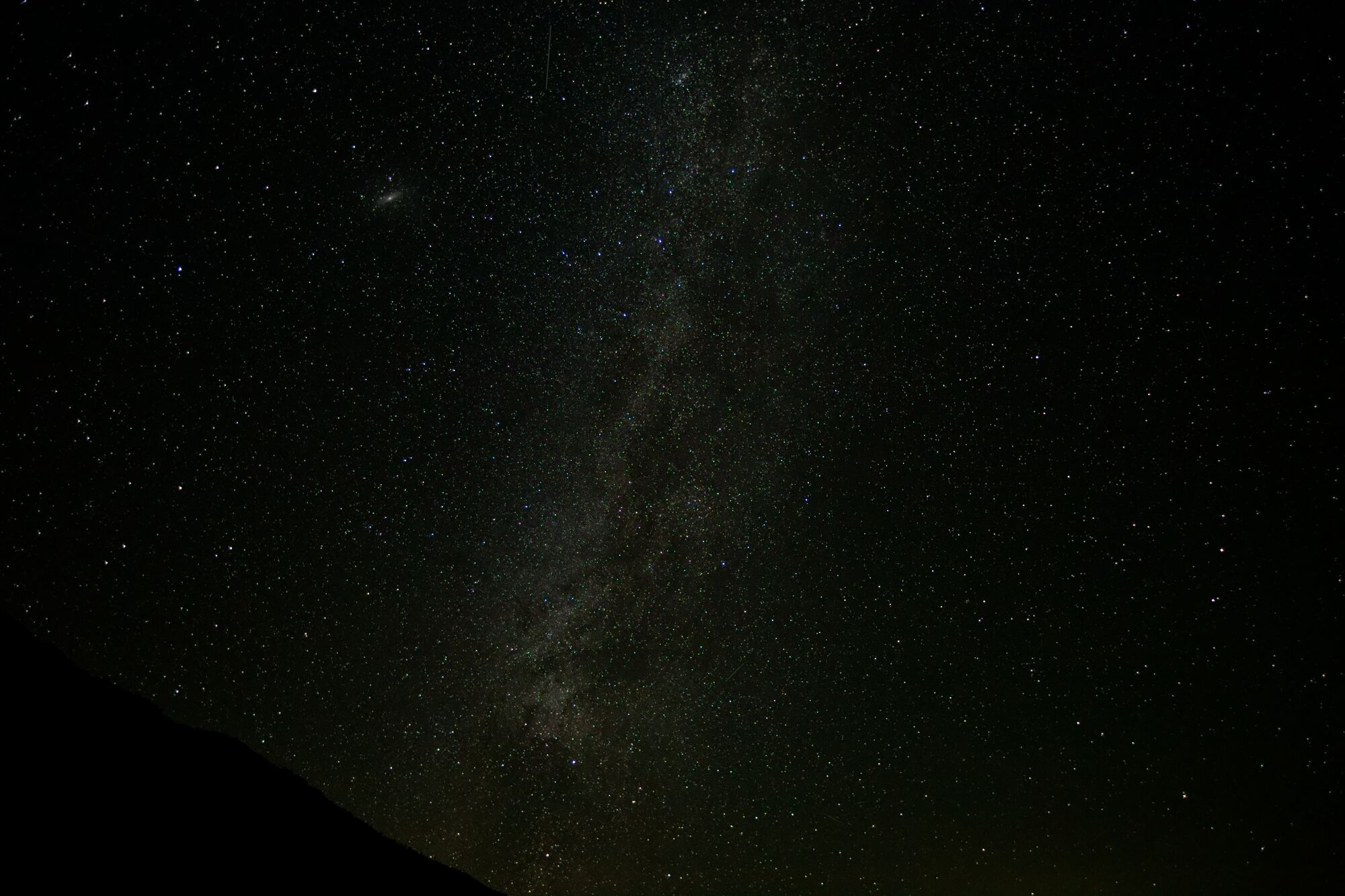
Parallax gets shakier the farther you look, which is why a few stars in the viewer show a range of published distances instead of a single number. Orion is the best example, and we will get there.
The Big Dipper: five relatives and two strangers
The Dipper is the perfect first lesson, because it is both a trick and a truth. Switch the viewer to it and slide sideways. Five of the seven stars, Merak, Phecda, Megrez, Alioth and Mizar, bunch up between 79 and 84 light-years from us. They are a genuine family, born from the same cloud and still drifting through space together as the Ursa Major Moving Group, one of the closest star groups to us.
Then there are the two outsiders. Dubhe, at the lip of the bowl, is about 123 light-years away. Alkaid, at the tip of the handle, is about 104. Neither belongs to the family, and both are heading in different directions from the other five. Give it roughly 100,000 years and the Dipper you know will have bent out of recognition.
My favorite detail: Dubhe and Merak are the famous Pointer Stars, the pair you follow to find Polaris. They look like twins, but Merak is 79 light-years away and Dubhe is 123. That is a gap of about 44 light-years, or roughly 259 trillion miles (416 trillion km), between the two stars everyone teaches you to treat as a matched set. And Polaris, at the end of that line, is around 446 light-years out. The pointers are aiming you at something roughly four to six times farther than either of them.
Even the timing is out of sync. The light reaching your eye from Dubhe set out about 123 years ago, around when the Wright brothers were getting their first airplane off the ground. Merak’s light left about four decades later.
Cassiopeia: a W that is really a staircase
Cassiopeia is my go-to for a jaw drop. The W looks like five stars standing shoulder to shoulder. In reality, Caph, one tip of the W, is 54.7 light-years away, about 322 trillion miles (518 trillion km). Gamma Cassiopeiae, the star in the middle, is roughly 550. The center of the W is about ten times farther than the end of it.
Even the closest pair in the pattern is not close. Caph and Ruchbah (99.4 light-years) are still about 45 light-years apart in depth, around 263 trillion miles (423 trillion km).
Gamma Cassiopeiae is a character, too. It is a fast-spinning blue star whose brightness has swung between about magnitude 1.6 and 3.0, so the middle of the W sometimes outshines its neighbors and sometimes slinks into the background. Its light set out in the 1470s, roughly two decades before Columbus sailed. Caph’s light left in the early 1970s.
Orion: Belt stars that are not on speaking terms
Orion’s Belt is where I grin the most. Three stars, nearly in a line, nearly evenly spaced, nearly the same brightness. They look like triplets. They are not. Alnitak and Mintaka sit roughly 1,200 light-years out, while Alnilam in the middle is farther still, up to about 2,000 light-years, which is around 11.8 quadrillion miles (18.9 quadrillion km).
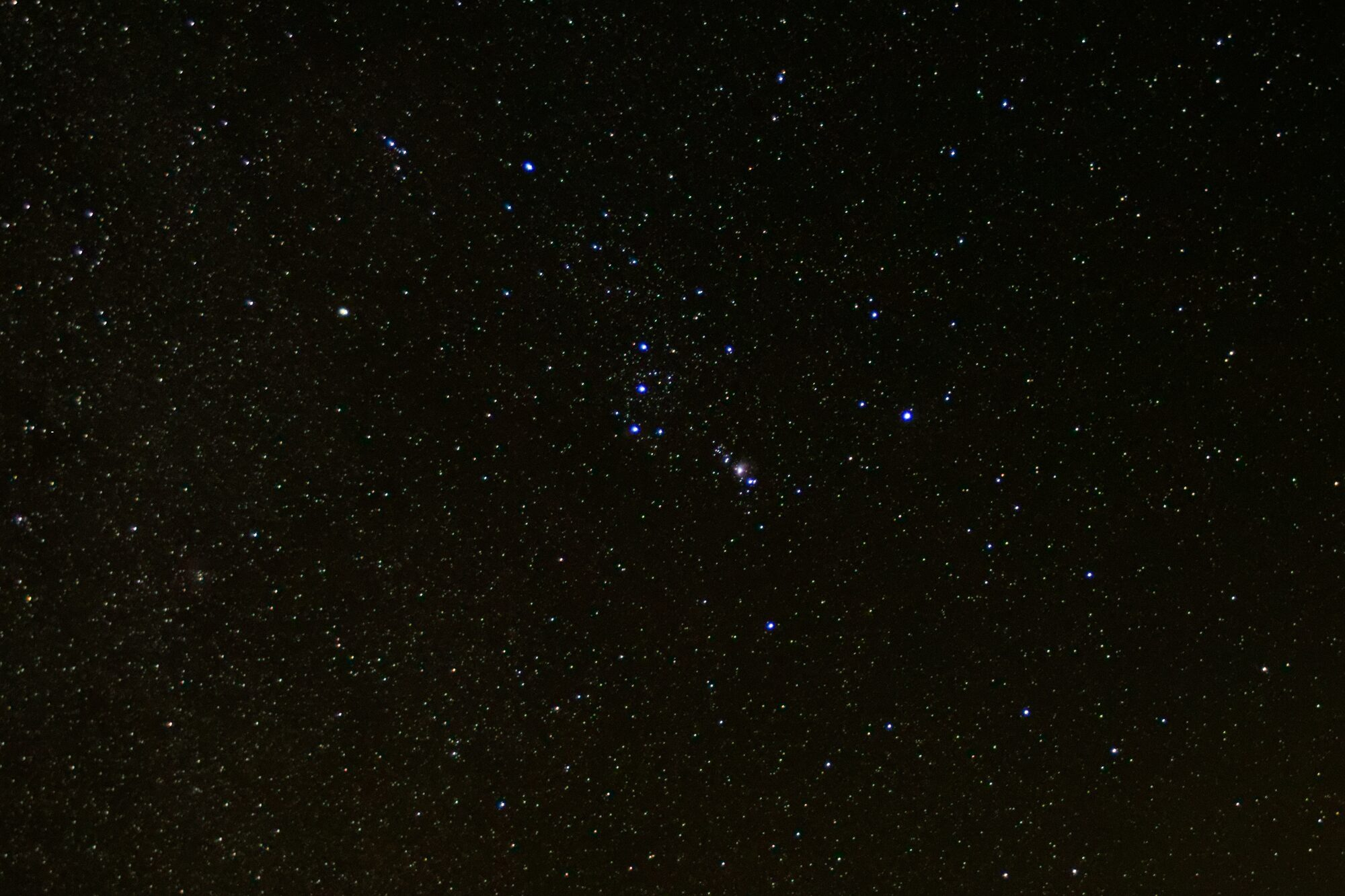
Here is the honest part nobody puts on a poster: those distances come with big error bars. Parallax is hard for bright, distant stars, and published values for the Belt stars disagree by hundreds of light-years. That is why the viewer shows a range for each Orion star. What every source agrees on is the pecking order. Alnilam is the farthest of the three, Bellatrix (about 250 light-years) is the nearest of Orion’s seven main stars, and Betelgeuse is closer than Rigel.
Run the clock back and it gets stranger. If the 2,000 light-year estimate is right, the light from Alnilam set out around when Tiberius was emperor of Rome. Even the nearest published estimate sends it off in the late 600s. The middle of the Belt is showing you a postcard from the distant past, and its neighbors are mailing you different postcards from other centuries.
Double stars: two look-alikes, two different stories
Sometimes two stars really do sit side by side in the sky. The question is whether that is a coincidence or a relationship. Astronomers call the coincidence an optical double. The relationship is a binary, or bound system, where gravity ties the stars together and they orbit a shared center. The second kind is everywhere. A big share of Sun-like stars come with a companion, and even Alpha Centauri, the nearest star system to us at 4.37 light-years, is a triple.
Alpha Capricorni: strangers on the same line of sight
Find Capricornus on an autumn evening and you can split Alpha Capricorni with your eyes alone. The two stars sit about 0.1 degrees apart, roughly one fifth the width of the full Moon. Algedi, the closer one, is about 109 light-years away (641 trillion miles, or 1,031 trillion km). Prima Giedi is far behind it, roughly 840 light-years out, though published estimates run from 570 to 870. Open the viewer on this pair and slide sideways. They come apart, because nothing connects them at all.
Mizar and Alcor: the real thing
Now flip to Mizar and Alcor in the Dipper’s handle. They sit about 0.2 degrees apart, a bit more than a third of the Moon’s width. For centuries people treated this pair as an eyesight test and assumed it was a coincidence. Then in 2009, astronomers found that Alcor is itself a binary, and that Alcor and Mizar move together through space. Mizar was already a quadruple, one of the first stars ever split in a telescope back in the 1600s. Put it together and you get a six-star system, with its two halves roughly 0.4 to 1.2 light-years apart (2.4 to 7.1 trillion miles, or 3.8 to 11.4 trillion km). The exact distances are still uncertain, but most studies since 2009 point to a true family.
The Pleiades: the opposite of a constellation
After all this talk of strangers, here is a group that really is a family. The Pleiades, also called the Seven Sisters, sit about 440 light-years away (2.6 quadrillion miles, or 4.2 quadrillion km), and unlike the stars of a constellation they are true neighbors. They were born together from one cloud of gas roughly 100 million years ago and still travel through space as a pack. Most people count six or seven stars with their eyes alone, and a camera on a dark night picks up the soft blue haze of the dust cloud the cluster is drifting through. Look for it on an autumn or winter evening.

Try this the next time you are out
Next time you are outside after dark, try four things:
- Find Cassiopeia and remind yourself that the W is a staircase, with one tip about ten times closer than the middle.
- Split Mizar and Alcor in the Dipper’s handle, then split Alpha Capricorni, and decide which pair is friends and which is strangers.
- Look at Orion’s Belt and think of Alnilam as the one standing at the back.
- Find the Pleiades and enjoy a group whose stars really are neighbors.
One caution, and it is a good segue: all of this gets easier under dark skies. In a bright city or suburb, the faint partners vanish first. Alcor and Prima Giedi are both around magnitude 4, and from a bright suburb you can lose them entirely, along with many of the stars that make a constellation feel deep.
Find a dark sky near you
That is the part I never get tired of. The more stars your eyes can reach, the more depth the sky gives back, and a truly dark site gives you far more of both. The viewer showed you how far apart the “neighbors” really are. The next step is to go stand under them.

If you are not sure where your nearest dark sky is, I put together a free guide to help you find dark skies near you. Grab the guide here, pick a clear night, and go meet the stars that are really out there.
Leave a Reply