This post contains affiliate links. As an Amazon Associate I earn from qualifying purchases. If you click a link and make a purchase, I may receive a small commission at no extra cost to you.
Key takeaways
- San Francisco is one of the very few major cities where you can still pick out constellations. Drive a couple of hours and you get the Milky Way with its dust lanes showing.
- Downtown at Rincon Park, right under the Bay Bridge, I measured 17.50 and called it a Bortle 8. Cygnus, Aquila and Cassiopeia were all readable, which is not something I can say about most downtowns.
- The Golden Gate overlook in the Marin Headlands is 30 minutes from the city and came in at 19.37, a solid Bortle 5, with a very faint Milky Way. Headlights on the road are the one thing working against you.
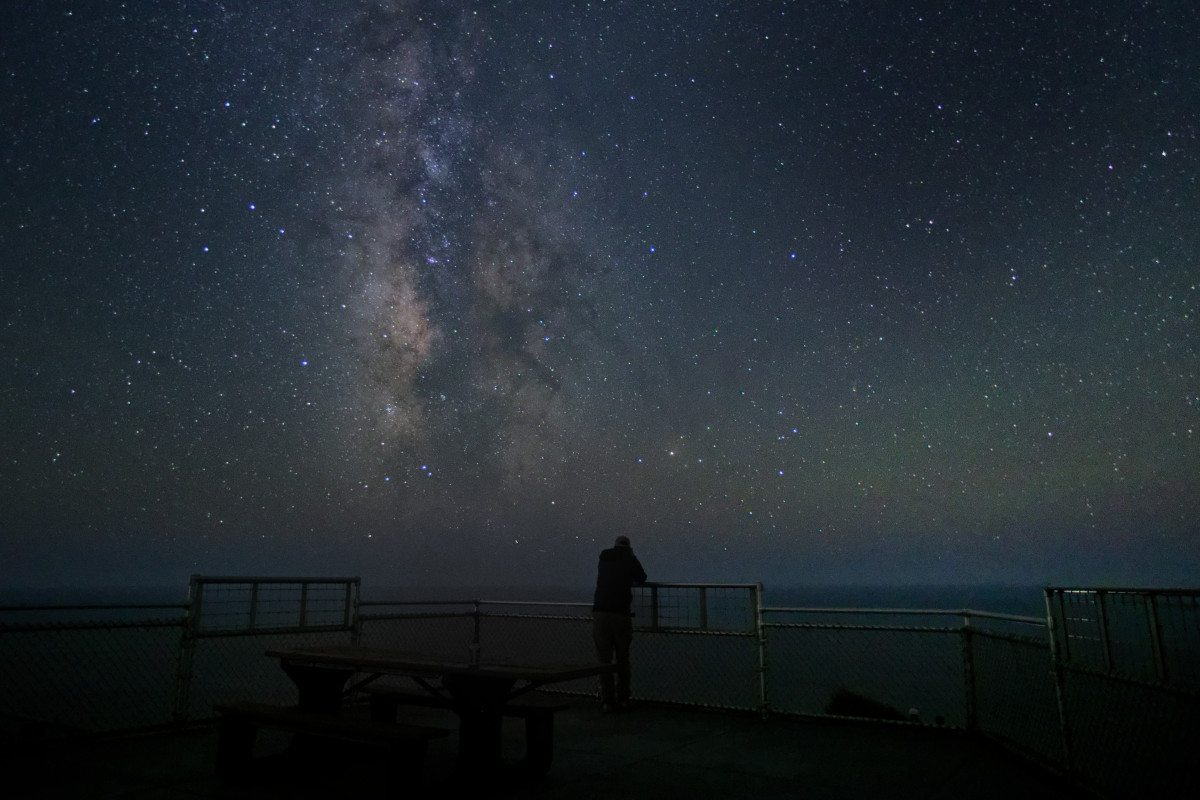
- Point Reyes Lighthouse is the one worth planning around. 21.16 and a true Bortle 3, with dust lanes in the Milky Way spilling down over the Pacific. Fog is the gamble, and wind and moisture are the price of admission.
New to the numbers? The Bortle scale runs from 1, the darkest skies left on Earth, to 9, an inner city where the constellations disappear. Sky brightness is measured in mag/arcsec², where a higher number means a darker sky. A Bortle 3 is a properly dark rural sky, dark enough that the Milky Way still shows real structure overhead.
Introduction
I was excited to test San Francisco, mostly because of the bay. You have a dense, vertical city sitting right on the edge of a huge sheet of open water, and I was curious what that does to the light pollution. Add the light show on the Bay Bridge and I went in expecting one of the brighter cities I have measured, especially for its size.
The plan was simple. Take an honest downtown baseline, then work outward and see how far you have to go to find a real dark sky. I wanted to know whether the Greater Bay Area could hand you a Bortle 3 without an all night drive.
Three sites over two nights, starting in the middle of the city. Here is what the meter said, and more importantly, what my eyes said.

Want to experience the awe and beauty of being under a truly dark sky?
Get expert help putting together a life-changing night under the stars: the ultimate astro vacation.
Plan my tripTesting San Francisco stargazing sites for light pollution
Rincon Park, downtown San Francisco
Clear skies. Metered straight up from the waterfront after astronomical darkness, with the high rises behind me and the bay in front.
We started at Rincon Park, a thin strip of grass on the Embarcadero almost directly under the west end of the Bay Bridge. It is about as downtown as you can be while still having open sky overhead, with the high rises immediately behind you and the whole bay opening up in front. That is exactly the spot I wanted, because a city baseline has to be taken somewhere defensible. Get too close to a single fixture and you are just measuring a streetlight. Drift too far out and you are quietly measuring the suburbs while calling it downtown.
I waited for astronomical darkness and took the reading, and it came back at 17.50. I was a little surprised, because I honestly expected worse. My guess before the trip was a high 16 or a low 17, which would have put this squarely in Bortle 9 territory.
Then I looked up, and that is where it got interesting. I could see a real number of stars. Several within Cygnus, several in Aquila, and Cassiopeia was sitting there plainly. At 17.50 this sits right at the start of Bortle 8, and for once the meter and my eyes told the same story. A 9 is a sky where the constellations themselves come apart, and these were holding together fine.
That is not always how it goes. In Austin the meter came back at 17.40 and put the sky in class 9, while what I was actually looking at was still an 8. In a city the sensor is measuring a diffuse wash of glow that human eyes are much better at seeing past, so the number tells you the sky is bright and your eyes tell you what you can still do with it. San Francisco just happened to be a night where the two agreed.
My read is that the bay is doing some of the work. Looking out over that much open water, there is simply less city between you and the sky in that direction, and no surface out there throwing light back up at you. For comparison, downtown Houston metered 16.42, a genuine Bortle 9, and the constellations there were nothing like this readable.
What that means practically: if you are staying in San Francisco and there is no moon, you can do basic stargazing and actually identify constellations from the waterfront. That is nothing to take for granted this close to a city this size.

Golden Gate overlook, Marin Headlands
Clear skies. Metered from the overlook above the bridge, roughly 545 feet (166 m) up, between passing cars.
From downtown we crossed the Golden Gate Bridge and climbed up to the overlook on the Marin side, the one everybody knows for the postcard view back at the bridge and the city. It is about 30 minutes from downtown, which makes it the obvious first move for anyone staying in the city without a whole night to spend.
The reading came in at 19.37, a solid Bortle 5, and this one the meter and my eyes agreed on. I could see the Milky Way. It was very faint and you have to know what you are looking for, but give your eyes a little time and it is absolutely there. Plenty of stars out as well. Not a bad return for half an hour of driving from a major city.
The strange part of this spot is the split screen. Turn one way and you are looking at the lit city and the bridge. Turn the other and you are looking out at genuine darkness over the water.
The catch is the road. Cars come through and their headlights sweep the overlook, so it is not ideal if you are chasing dark adaptation or shooting long exposures. It was not heavy the night we were there, but it is not somewhere I would want to settle in for hours. If you want to escape that, park and walk. There is a trail nearby, and getting even a short way down it puts terrain between you and the road. Be sensible about it, because these are winding roads and steep drops in the dark, and some of the roads up here close at night.

Point Reyes Lighthouse
Clear, windy and damp. First clean reading 21.14, best 21.16, metered from the observation deck with the rock formation blocking the San Francisco light dome.
The next day we drove out to Point Reyes National Seashore. This is a place I had wanted to explore for years purely because of how it looks on a map, a long finger of land shoved out into the Pacific, and I had somehow never made it. It is a shade under two hours from the city, and the last stretch out the point is slow.
There is a lot to do out here in daylight. Elk, elephant seals, coastline for days. What ate our afternoon and sunset was the whales. They were going absolutely crazy off the coast, breaching over and over. I have done several whale watching tours and I have never seen anything like it even from a boat, much less the shore. It was one of the most entertaining things I have ever watched, and we barely moved for an hour.

One practical note. We came on Labor Day weekend and the whole coast was a madhouse. Thankfully the crowds thin out fast after sunset, which is exactly when you want to be here anyway. It is roughly half a mile (0.8 km) from the parking lot out to the lighthouse, and the lighthouse itself is closed at night, but you can walk right up to the observation deck.
That deck turns out to be a great place to stand. There is a big rock formation right behind it that blocks a serious amount of the light dome coming from San Francisco, and looking west you have nothing but ocean. That combination is the whole reason this site works.

The first clean reading was 21.14 and the best I got was 21.16. On the raw number that reads like a Bortle 4, and I am calling it a 3. The dust lanes in the Milky Way were clear, with real structure in them, spilling down toward the horizon over the water. Stars everywhere. There is a light dome back toward the city if you turn around, but out over the Pacific this is a properly dark sky, and an early September Milky Way sitting high pours light into the meter itself and drags the number down. That is the same thing that happened at Red Lake above Lake Tahoe.
Standing that close to the tip of the point with the Milky Way over the ocean, and the winds and seals howling below, was a surreal hour. There were a couple of other people around early on, and for most of the night we had it to ourselves.
Now the honest warnings. Point Reyes is widely called the foggiest place in the country, and it is often cloudy on top of that, so a clear night here is genuinely lucky rather than typical. Watch the forecast closely and be ready to move your plans.
Then there is the weather itself. It gets windy and cold, and the moisture is relentless. My camera lens was fogging so fast I was wiping it roughly every minute, every couple of shots, and eventually that is what ended our night. Sheltering behind the rock cut the wind exposure a lot and made it much more tolerable. Bring a puffer jacket, a beanie and gloves, and something to keep your lens dry.

Final word
San Francisco surprised me, and the bay is my best explanation for it. A city this dense usually does not leave you constellations so close to its high rises, and this one does. If you are staying downtown with no moon in the sky, go outside and look up. You will get something.
If you have half an hour, cross the bridge to the Marin Headlands overlook. A Bortle 5 with a faint Milky Way and the city glittering behind you is a good night, as long as you can live with headlights sweeping through.
And if you want the real thing, go to Point Reyes. A Bortle 3 with dust lanes over the Pacific is the best accessible dark sky I know of near San Francisco, and you have to travel a decent way north or south to find anything comparable. Just line up the weather first, because out there the sky being clear is the hard part, not the sky being dark.
Find the dark sky closest to you
Point Reyes is a good reminder that a dark sky trip is really two problems, not one. There is the question of where the darkness is, and there is the question of which night is worth driving for. Getting the first one right and the second one wrong is how people end up standing on a beautiful headland staring at fog.
Wherever you live, there is almost certainly a sky worth the trip within a couple of hours of your door, and a handful of nights each month when it is actually worth taking.
I put together a free guide on how to find dark skies near you, including how to read a light pollution map without being fooled by it and how to work out the nights that are genuinely worth your time. Grab the guide here and go find yours.
Leave a Reply