This post contains affiliate links. As an Amazon Associate I earn from qualifying purchases. If you click a link and make a purchase, I may receive a small commission at no extra cost to you.
Key takeaways
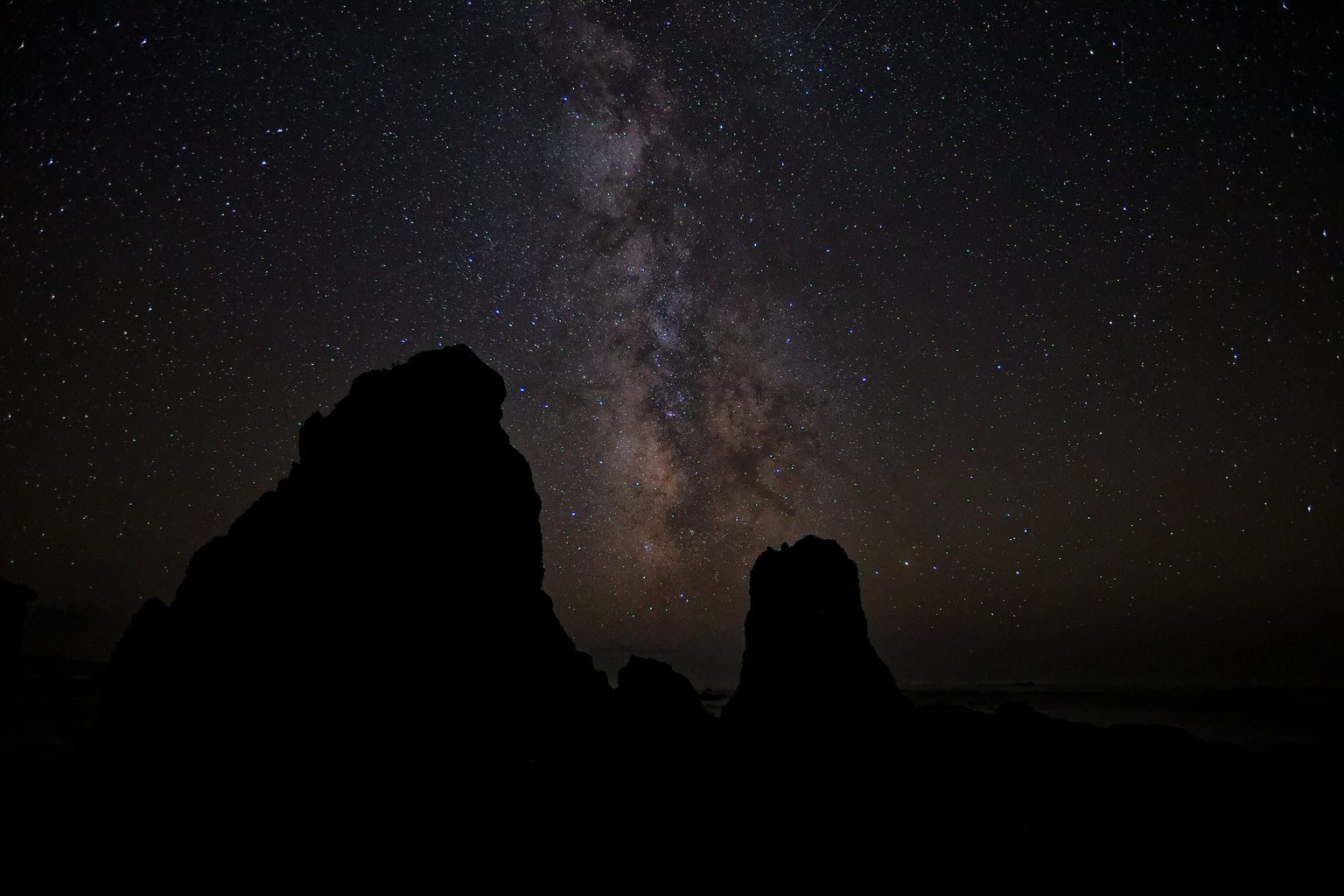
- The Lost Coast has some of the darkest skies I have stood under anywhere in California, dark enough that the Milky Way’s dust lanes looked like spilled ink. My meter read 21.41 mag/arcsec², and I called it a Bortle 2.
- I measured from a black sand beach off Mattole Road near Cape Mendocino, on the northern end of the Lost Coast. Facing the open Pacific, there is no city glow on the horizon at all.
- From Eureka it is about an hour and 15 minutes, which I think is the sweet spot for a stargazing drive: far enough to get properly dark, short enough that the drive home does not hurt.
- Watch the marine layer and clouds. It was socked in when we arrived and burned off right at sunset. Getting down to the beach also means a careful scramble over steep rocks.
New to the numbers? The Bortle scale runs from 1, the darkest skies left on Earth, to 9, an inner city where the constellations disappear. Sky brightness is measured in mag/arcsec², where a higher number means a darker sky. A Bortle 2 is a truly dark sky, dark enough that your surroundings show only as silhouettes against the sky.
Introduction
Someone in my social media comments mentioned the Lost Coast and how good the stargazing could be out there, and it was not even on my radar. We were staying in Eureka at the time, so I pulled up a map and realized a good stretch of the Lost Coast was only about an hour and 15 minutes away.
That drive time is kind of perfect for stargazing. It is far enough to reach a seriously dark sky from a lot of places, but short enough that the drive back is not a slog, especially when you are still buzzing from a great night. So on a Saturday night, I skipped college football (not easy for me), loaded up the sky quality meter, and headed south. It was absolutely the right call.

Want to experience the awe and beauty of being under a truly dark sky?
Get expert help putting together a life-changing night under the stars: the ultimate astro vacation.
Plan my tripTesting Lost Coast stargazing sites for light pollution
Black sand beach off Mattole Road, near Cape Mendocino
Cloudy on arrival, fully clear by true darkness with very good transparency. Metered from the beach with the open Pacific to the west.
To get here, we drove south of Eureka and picked up Mattole Road, which runs along the coastline on what is considered the northern part of the Lost Coast. Most of the Lost Coast has no road running through it at all. It is primitive and rugged, and that is exactly what makes the place so special. So while we were on the Lost Coast, I would not say we were in the heart of it. It is still a stunning stretch of California.
This is the area around Cape Mendocino, the westernmost point of California, which was pretty cool to see in person. Just offshore sits Sugarloaf Island, a big sea stack that marks that western edge. Nearby there is also a rock formation that looks exactly like a battleship, which is why it goes by Battleship Rock.
What I love most about this part of the coast is the black sand beaches. We spent the evening exploring one of them, poking around tide pools and the rocky stretches of shoreline. We also drove inland toward Petrolia, a tiny town tucked into the hills, and on the way back out we passed a zebra running through a field.
Then, back at the coast, we caught a waterspout spinning off the Pacific, which I think is pretty rare for this part of the country. It was already a strange and wonderful evening before a single star came out.

For the night itself, we posted up near one of the sea stacks and waited for sunset.
A quick heads up on access: getting down to these beaches means climbing down some steep rocks. If you have mobility concerns, this could be tricky, so keep that in mind. If you are reasonably able-bodied and take your time, you should be able to get down safely.
Once you are on the beach, the sand is the pebbly kind, the kind that does not work its way into every crack and crevice of your gear (and body), which is a nice bonus. We threw down a towel and settled in.
Traffic was not an issue. Every now and then a car would come down Mattole Road, but not often, and we had the beach completely to ourselves on a Saturday night.
Now, the clouds. When we arrived it was extremely cloudy, and they kept drifting on and off through the evening. I was not sure we would get a sky at all. Then, as the sun went down, the clouds just burned off. By the time true darkness set in, the sky was completely clear, and the transparency felt very good. We got lucky, and I will take it.

Before I took the reading, I guessed around 21.3, maybe 21.4, since this area is supposed to have some of the darkest skies in California. The meter came back at 21.41. On paper that number sits in Bortle 3 territory, but I am calling this a Bortle 2, and I think the sky backs that up. The Milky Way was simply there, super bright, with a ton of structure, and the dust lanes overhead were very dark. There were shooting stars all night. If anything, it felt like it was trending closer to a 1.
Why the gap between the meter and my eyes? When the Milky Way is riding high and bright, it pours extra light into the sensor, so at a truly dark site the reading can come out a little brighter than the sky deserves. The other big factor here is the ocean. Looking out over the Pacific, there is no town, no highway, and no light dome sitting on the horizon. The whole western half of the sky is clean right down to the water, and that is something a meter pointed overhead does not really capture.

Final word
There is something special about the Lost Coast. It feels remote in a way very little of California does, it is dark, and it is beautiful even before the sun goes down. It is a long way from San Francisco and even farther from anywhere in Southern California, and that distance is a feature. It is what keeps the crowds away.
The one thing you have to plan around is the weather on this part of the coast. Clouds, marine layer, and fog can shut the whole show down, so keep a close eye on the forecast and be ready to wait them out like we did. Get that part right, and you are in for prime stargazing in one of the most iconic spots in the state. I would come back in a heartbeat, and a huge thank you to whoever dropped this one in my comments.
Find your own Lost Coast night
Not everyone has the Lost Coast an hour down the road, but almost everyone has a sky like this closer than they think. The trick is knowing where to look and what to watch for, whether that is a light dome on the horizon or a marine layer that might burn off at sunset. I put together a free guide that walks you through finding dark skies near you, so your own bucket list night under the stars is a lot easier to plan. Grab the guide here.