This post contains affiliate links. As an Amazon Associate I earn from qualifying purchases. If you click a link and make a purchase, I may receive a small commission at no extra cost to you.
Here’s something that blew my mind when I first really understood it: on a clear night, your eyes alone can reach across millions of light-years of space and detect the light of entire galaxies. Not with a telescope. Not with binoculars. Just you, the dark, and 40 minutes of patience.
There are five galaxies you can see with the naked eye. Let’s go find them.
Northern Hemisphere: The Big Three
If you’re in the northern hemisphere, you’ve got up to three galaxies accessible to you, ranging from surprisingly easy to very challenging.
The Andromeda Galaxy (M31) — ~2.5 Million Light-Years Away
Andromeda is the crown jewel of naked-eye deep sky objects, and for good reason. It’s one of the most distant things a human being can see without any optical aid — a faint, elongated smudge of light that left its source before our species even existed.
You’ll find it easiest in the fall evening sky, when the constellation Andromeda rides high. It’s also well-placed in the early morning summer sky if you’re an early riser. Look for it just off the corner of the Great Square of Pegasus — use the chain of stars in Andromeda as a signpost and you’ll land right on it.
Here’s the good news: Andromeda is actually visible even from suburban skies under decent conditions. You don’t need to be in the middle of nowhere to catch it. That said, if you really want to appreciate it — to see its full extent, that elongated glow stretching across a degree or more of sky — you want to get yourself out to a Bortle 3 or darker site. Under truly dark skies, Andromeda is humbling. It becomes an obvious, undeniable presence rather than a “wait, is that it?” smudge.

The Triangulum Galaxy (M33) — ~2.8 Million Light-Years Away
M33 is the underdog of this list, and finding it with your naked eye is a real accomplishment to be proud of.
It sits in the small constellation Triangulum, close neighbors with Andromeda in the sky, and it’s best viewed on the same fall evenings or summer mornings as its larger sibling. The problem? It’s significantly fainter than Andromeda, and its surface brightness is spread out across a large area — which means it can be maddeningly difficult to see even when it’s technically “there.”
For Triangulum, you want a truly dark sky. Bortle 3 or better, no question. And two things will make or break your attempt:
Let your eyes fully dark-adapt. Your eyes are still optimizing well past the point where most people give up and call it good enough. It takes a full 40 minutes for your eyes to adapt. The difference between 20-minute eyes and 40-minute eyes is enormous.
Use averted vision. Instead of staring directly at where M33 should be, look slightly to the side of it. Your peripheral vision is more sensitive to faint light than the center of your eye, and this trick alone can mean the difference between seeing it and not. Averted vision is the secret weapon of serious observers — use it.
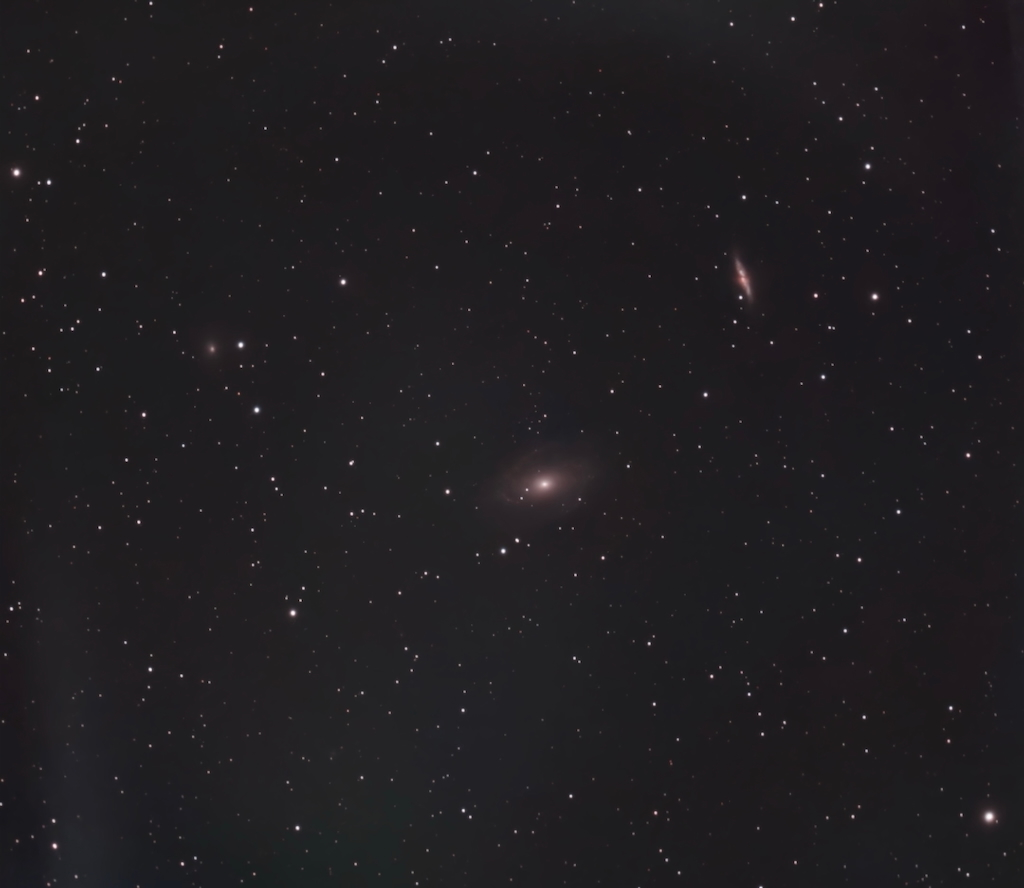
Bode’s Galaxy (M81) — ~12 Million Light-Years Away
Okay, this one is genuinely reserved for the best of conditions and observers with exceptionally sharp eyes. At around magnitude 6.9, M81 sits right at the theoretical limit of human vision and that limit assumes perfect dark skies, full dark adaptation, and frankly, eyes that are on the better end of the spectrum.
If you’re going to attempt it, you need everything working in your favor: a moonless night, a pristine dark sky site, that full 40-minute dark adaptation, and averted vision used aggressively. It lives up near Ursa Major, so it’s a northern circumpolar object visible year-round from most of the northern hemisphere — but only worth hunting naked-eye when conditions are exceptional.
Spotting Bode’s Galaxy with the naked eye is bragging rights territory.

Southern Hemisphere: The Magellanic Clouds
Now, if you’re lucky enough to be in the southern hemisphere — or planning a trip south of the equator — you’re in for something extraordinary. Two galaxies that are completely invisible from northern latitudes hang prominently in the southern sky like pieces of the Milky Way that broke off and went exploring.
The Large and Small Magellanic Clouds
These are not subtle. They look exactly like what they sound like — detached fragments of the Milky Way, glowing cloud-like patches drifting in the southern sky. From a dark site south of the equator, they’re genuinely hard to miss on a clear night.
But don’t let the “cloud” appearance fool you: these are entire dwarf galaxies gravitationally bound to our own Milky Way. The Large Magellanic Cloud sits around 160,000 light-years away; the Small around 200,000. They’re our closest galactic neighbors, and they are spectacular binocular objects even before you consider what you’re actually looking at.
Here’s a detail that never gets old: tucked inside the Large Magellanic Cloud is the Tarantula Nebula — one of the most intense star-forming regions in the entire Local Group of galaxies. If the Tarantula Nebula were as close to us as the Orion Nebula, it would cast shadows on Earth at night! That’s the scale of what you’re looking at.
Want to Find a Dark Sky Near You?
Everything I’ve described above gets dramatically better the darker your skies are. The difference between a Bortle 6 suburban sky and a Bortle 3 rural sky isn’t just noticeable — it’s transformative. Objects you’ve been squinting at suddenly become obvious. The sky stops being a flat backdrop and starts having depth.
If you’re ready to chase genuinely dark skies, I’ve put together a guide to help you find the best sites near you:
Clear skies and wide eyes — it’s all out there waiting for you.