This post contains affiliate links. As an Amazon Associate I earn from qualifying purchases. If you click a link and make a purchase, I may receive a small commission at no extra cost to you.
Most places on this list will reward you with spectacular skies. A handful will also give you a landscape that makes you question reality a little. Mauna Kea does both.
You’re standing at the summit of the tallest mountain on Earth, depending on how you measure it — a volcano rising from the middle of the Pacific Ocean, so far from any city light that the darkness here is some of the best you’ll see.
Add world-class observatories silhouetted against that sky, snow on the ground, and the fact that you’re still technically in Hawaii, and you start to understand why this place breaks people’s brains a little. This one is special. Let’s get into it.
Overview
- Dark Sky Dispatch Location: Mauna Kea, Big Island, Hawaiʻi
- Bortle Class: 1–2 (summit and surroundings)
- Summit Elevation: 13,796 feet above sea level
- Visitor Information Station (VIS) Elevation: 9,200 feet
- Best Season: Year-round; Milky Way core peaks March through October

What You’ll See
Ink-black skies above the clouds, the Milky Way in full force, and several world-class observatories perched on the horizon like something out of a science fiction film.
For visitors from the continental US, this is also one of your best shots at southern sky objects that simply aren’t accessible from home. And if you happen to visit in winter — yes, there’s snow. In Hawaii. We’ll get to that.


Accessibility
You can drive to the Visitor Information Station at 9,200 feet in a standard vehicle. Getting to the summit (13,796 feet) requires a 4WD — and more importantly, a healthy respect for altitude.
The rapid gain from sea level to nearly 14,000 feet in a matter of hours is not something your body takes lightly, even if you’re experienced at altitude. Good idea to proceed with a little bit of caution, especially if you’re a flatlander.

Field Notes
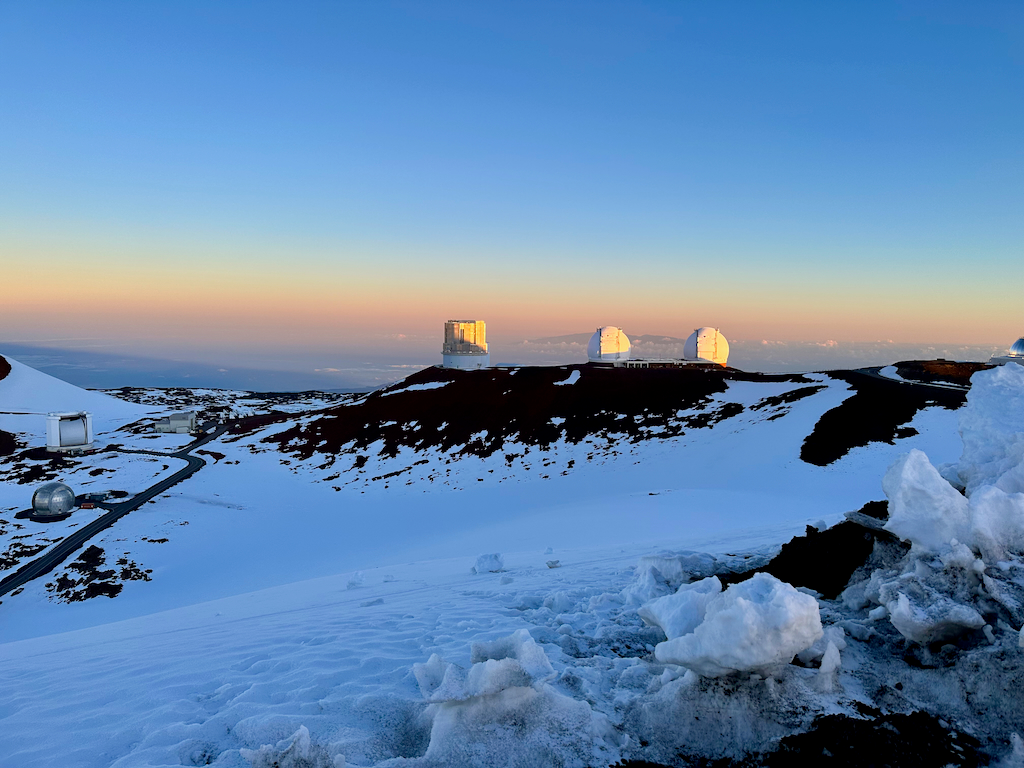
We went up for the sunrise, and I’ll just say: watching the sun come up from the summit of Mauna Kea, surrounded by observatories, with the cloud layer sitting far below you, is one of the most bucket-list things I’ve ever done.
It requires an early start and it is absolutely not for the Hawaii vacationer who wants to sleep in and enjoy the beach at a civilized hour. But if you’re willing to drag yourself out in the dark, it pays off in ways that are hard to explain until you’re standing there.
We visited in March, when there was still snow on the mountain. A lot of people don’t know that it snows in Hawaii at elevation — but it does, and there’s something surreal about grabbing a handful of Hawaiian snow.
Some people even snowboard up here, which is a limited but fascinating pastime and exactly the kind of thing that makes this place defy easy categorization.
The drive itself is an experience.
As you gain elevation, the skies darken in a way that builds anticipation mile by mile. What’s unusual about Mauna Kea compared to other high-altitude destinations I’ve been to — including driving up Mount Evans to 14,000 feet in Colorado and spending extended time in Leadville at over 10,000 feet — is that you’re starting from sea level. That compressed elevation gain is a completely different physiological experience than approaching altitude from altitude.
This is exactly why the acclimatization stop at the Visitor Information Station is mandatory, not optional.
They will not let you drive to the summit without checking in there first. A 4×4 is required to go up all the way to the top and keep in mind that some rental companies don’t let you drive to the top.
They also make sure you understand how to manage your brakes on the descent — which is critical. The grade coming down is serious, and you have to know to use engine braking rather than riding your brakes, or you will burn them out. If your brakes are too hot on the way down, they’ll make you take a pit stop.
If you have any uncertainty about altitude or your driving ability, a guided tour is genuinely worth considering here.
The VIS itself is a legitimate dark sky spot.
While we waited for clearance to head up, we wandered the area and the Milky Way was out in force. There are a few offshoot trails that get you away from the parking lot — which you’ll want, because headlights from arriving cars will wreck your dark adaptation fast. It’s not a perfect setup, but the sky overhead is legitimately impressive. I don’t have an exact Bortle reading for that elevation, but your eyes will tell you what you need to know.


After getting the all-clear at the gate, we made the summit just before first light.
What followed was one of those mornings I’ll keep coming back to. The sunrise came up slow and dramatic, with the observatory silhouettes doing what they do — making the whole scene look almost too cinematic to be real.

On the observatories: they’re a genuine point of tension.
The summit of Mauna Kea is considered sacred by Native Hawaiians — Mauna a Wākea, the firstborn of the sky father and earth mother, the place where the spiritual and physical realms meet.
The presence of thirteen telescopes from eleven countries on that ground is not a settled issue, and it’s a conflict that deserves awareness for any visitor.


What I can say is that the research happening up there is among the most significant in the world, and that complexity is part of the story of this place. Come with awareness of it.

My honest bottom line:
Mauna Kea is one of the most extraordinary places I’ve ever been, full stop. The drive, the snow in Hawaii, the dark sky stop at the VIS, the summit sunrise with the observatories — it’s a sequence of experiences that stacks on itself in a way that few destinations can match. The altitude is real and deserves respect, but if you plan for it, this is absolutely worth doing.