This post contains affiliate links. As an Amazon Associate I earn from qualifying purchases. If you click a link and make a purchase, I may receive a small commission at no extra cost to you.
A lot of people who fall in love with astronomy find themselves wanting to learn the constellations.
So they start Googling. They download apps. The most ambitious among them pull up a list of all 88 constellations and think, I’ll just learn them all.
Others take a softer approach, soaking in whatever they can catch on a clear night.
Both approaches share the same problem: without a framework, the sky is just a beautiful, overwhelming canopy of twinkling pins.
But I’m here to tell you that you don’t need to learn 88 constellations.
And as a starting point, all you need are five connections. And if you’re in the northern hemisphere around spring and summer, these five will orient you across a huge swath of the sky.
Let’s walk through them.
1. The Big Dipper → Polaris (The North Star)
This is your anchor.
The Big Dipper is one of the most recognizable star patterns in the sky — seven bright stars forming a ladle shape. It’s visible year-round for most northern hemisphere observers, though in spring and summer it rides high overhead, while in autumn and winter it drops lower toward the northern horizon.
Find the two stars that form the outer edge of the dipper’s “cup” — these are called the Pointer Stars. Draw a line through them and follow it north. The first moderately bright star you hit, sitting almost perfectly still as everything else rotates around it, is Polaris. The North Star.
This is usually the first connection new astronomers learn and it’s incredibly helpful.

2. Arc to Arcturus → Spike to Spica
Now that you have your bearings, let’s swing south.
Look back at the Big Dipper. Follow the curve of its handle outward — don’t go straight, follow the arc. If you trace that arc long enough, you’ll arrive at a brilliant orange-yellow star blazing in the spring and early summer sky. That’s Arcturus, one of the brightest stars visible from Earth. The old memory trick writes itself: Arc to Arcturus.
But don’t stop there. Keep following that same arc, spike it straight down, and you’ll land on Spica — a blue-white star in the constellation Virgo. Spike to Spica.
This one sweep of the sky, spring through early summer, connects you to two of the brightest stars you’ll ever see and gives you a massive swath of the southern sky to work with.

3. Leap to Leo
While you’re in the neighborhood of the Big Dipper, here’s another trick worth knowing.
Take those same Pointer Stars you used to find Polaris — but this time, go the other direction. Follow the line south instead of north, and you’ll drop right into Leo, the Lion. Look for a backwards question mark shape (called the Sickle) representing the lion’s head and mane, with a bright star — Regulus — sitting at the bottom.
Leo is a spring constellation, best seen from roughly February through May. Regulus sits right along the ecliptic so it’s a great way to also track the path of the moon and planets.

4. The Summer Triangle
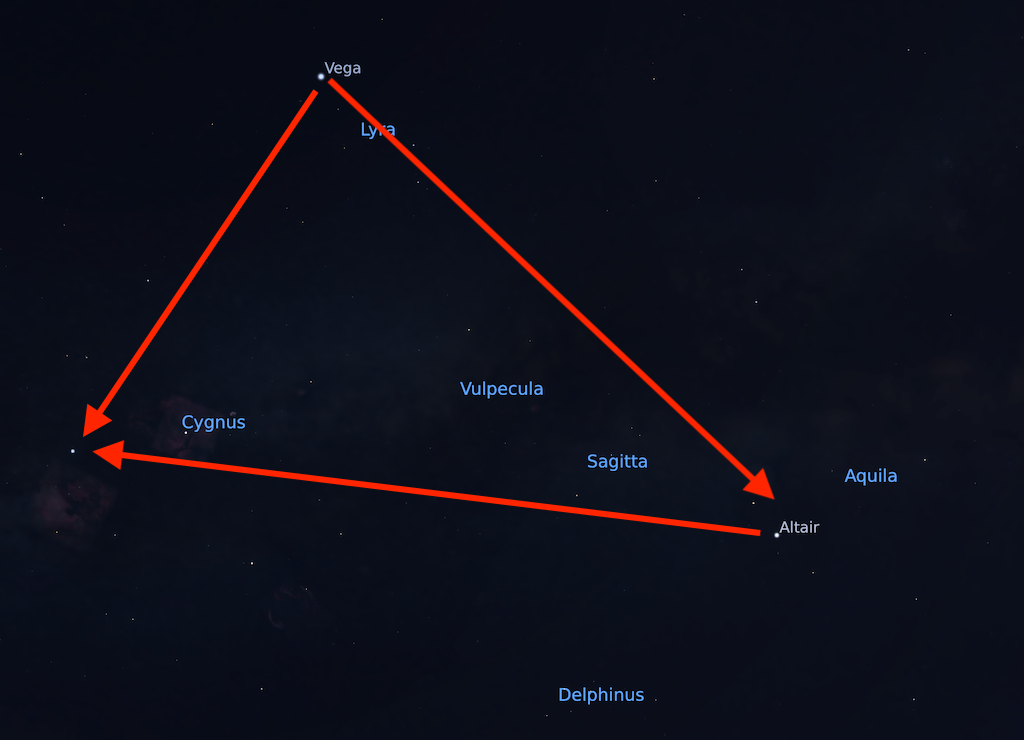
By midsummer, three brilliant stars dominate the overhead sky: Vega, Deneb, and Altair. Together they form the Summer Triangle. It’s not an official constellation, but one of the most useful landmarks in all of amateur astronomy.
Vega, in Lyra, is the brightest of the three and one of the easiest stars in the sky to identify — dazzling white-blue, nearly overhead on July and August evenings. Deneb, in Cygnus the Swan, marks the tail of the swan and sits at the top of the Northern Cross asterism. Altair, in Aquila the Eagle, is the southernmost point of the triangle and notable for spinning so fast it’s actually slightly flattened at its poles.
The Summer Triangle is visible from roughly June through October. Once you lock it in, you’ve unlocked the heart of the summer Milky Way.

A Framework, Not a Finish Line
Here’s what these five connections give you: a scaffold. The Big Dipper is your home base. From it, you can arc and spike your way to two brilliant stars, leap south into Leo, and look straight up in summer to find the triangle burning overhead. In a single season, you’ve gone from lost to oriented.
The sky will still surprise you. It should. But now when you look up, you’re not staring into chaos — you’re reading a map you helped draw yourself.
That feeling doesn’t go away. It gets better.
Ready to Take It Further?
If this has you fired up to get out under a dark sky, the next step is making sure you have the right telescope with you when you go. Not sure where to start? I put together a free PDF telescope cheat sheet that breaks down which scope might be right for you, the specs that actually matter, and how to set a budget before you buy. Grab it — it’ll save you a lot of second-guessing before your first real dark sky night.