This post contains affiliate links. As an Amazon Associate I earn from qualifying purchases. If you click a link and make a purchase, I may receive a small commission at no extra cost to you.
Key takeaways
- Houston sits under one of the brightest skies in the country, and because the city is spread over so much ground, the glow does not fade the way it does around a compact city. You have to drive a real distance, and what you reach is a decent suburban sky rather than a dark one.
- Downtown came in at 16.42, a Bortle 9. I counted one star. The planets were the entire show.
- Johnson Space Center bought us exactly one Bortle class, at 17.2. The suburban belt is not the escape it looks like on a light pollution map.
- Jamaica Beach on Galveston’s West End was the one worth the drive: 19.2, a Bortle 5, with the Milky Way core coming up over the water. Beach stargazing this close to a city this size is genuinely rare.
New to the numbers? The Bortle scale runs from 1, the darkest skies left on Earth, to 9, an inner city where the constellations disappear. Sky brightness is measured in mag/arcsec², where a higher number means a darker sky. A Bortle 5 is a suburban sky, dark enough that the Milky Way shows overhead on a good night but washed out and invisible anywhere near the horizon.
Introduction
Houston is sprawling. Not just big, but spread out in a way that is hard to grasp until you are driving through it. The city proper covers roughly 640 square miles (1,660 km²), and that sprawl means the light pollution does not taper off the way it might somewhere more compact. Standing downtown, you are not just under a bright sky. You are under a bright sky that keeps going a long way in every direction before it starts to fade.
There is also nothing to hide behind. Downtown sits barely 50 feet (15 m) above sea level and the land stays flat for a very long way, so there is no ridgeline anywhere to block a light dome the way there would be in a hillier region. Head north and the terrain picks up a little, but not enough to matter. In a city built like this, Houston stargazing comes down to one question before anything else: which direction do you go?
There is a decent case for almost every one of them, and I will get into the alternatives at the end. We went south, toward Galveston, and I want to walk through why, because the reasoning ended up mattering as much as the readings did. Three stops, working out from the middle of downtown. Here is what we got.

Want to experience the awe and beauty of being under a truly dark sky?
Get expert help putting together a life-changing night under the stars: the ultimate astro vacation.
Plan my tripTesting Houston stargazing sites for light pollution
Downtown Houston, Buffalo Bayou Park
Clear overhead. Metered from a shadowed spot with no streetlight in direct line of sight, pointed straight up.
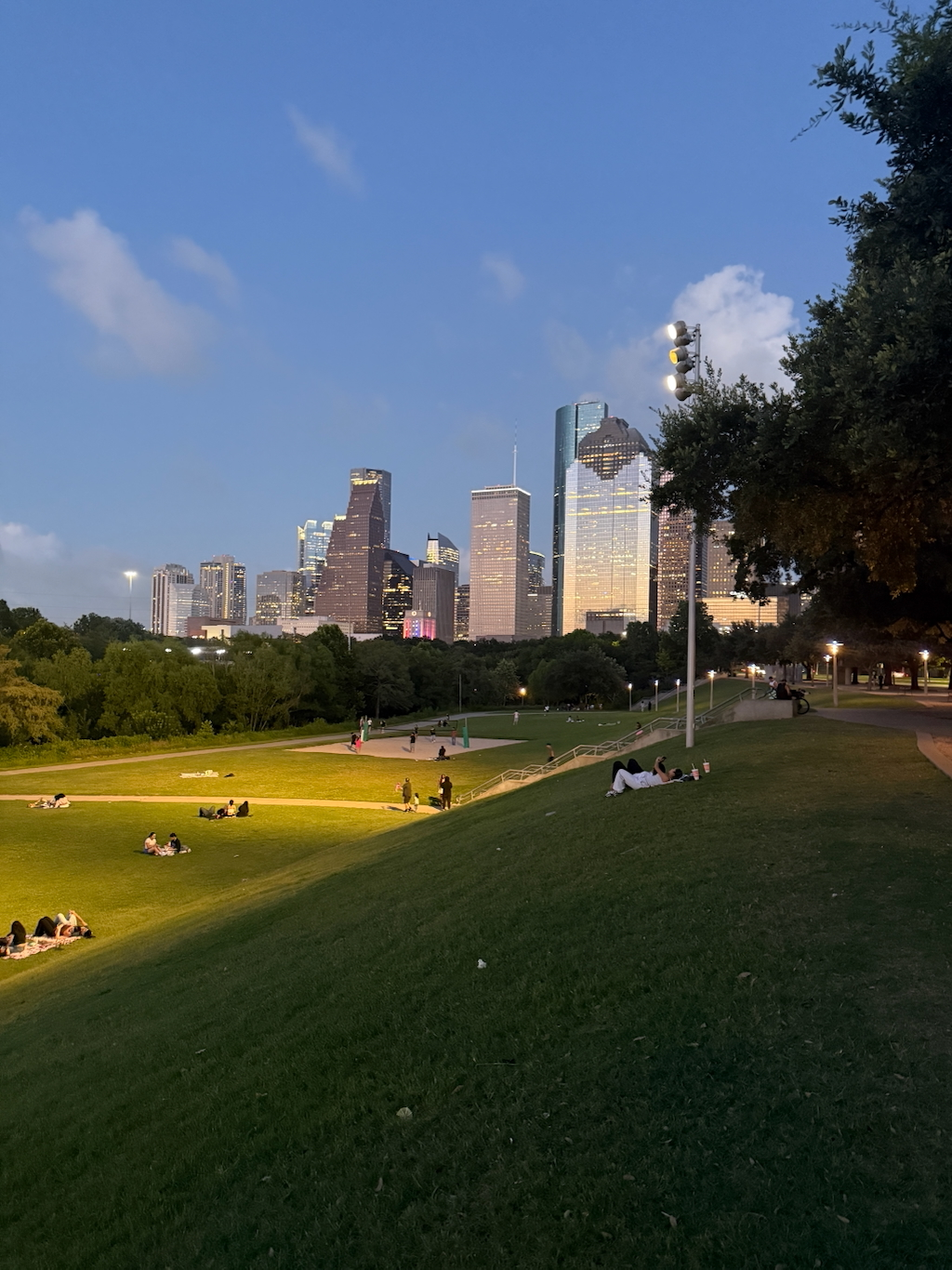
We started at Buffalo Bayou Park to get a baseline. My first thought had nothing to do with the sky: this is a genuinely great park. Huge, beautifully maintained, and the skyline view from it at night is one of the better city views in the country.
Which is exactly the problem. It is also extremely well lit, and that skyline is part of why this is one of the brightest skies in the United States. If you are staying downtown or in the Inner Loop, this is the sky you have.
I will be honest about the reading itself. Getting a clean SQM number this close to a downtown core of this size is hard, and I did not put much weight on the exact figure. What is the difference between hellishly bright and a little more hellishly bright? Not much. Still, I walked a few spots, found a shadowed pocket with no light fixture in direct line of sight, and pointed the meter straight up at a patch of clear sky.
It came back at 16.42, a Bortle 9. Remember that the scale runs backward from what you would expect, so 22 is about as dark as Earth gets and 16 is the floor. Sitting at 16.42 tells you how much glow we were standing in.
I looked up and found exactly one star. One. But Venus and Jupiter were both shining hard, which is the useful lesson from a night like this: the planets do not care how bright your city is. Even in the middle of the fourth largest city in the country, you can still go outside and find something.

Johnson Space Center
Clear skies. Metered from the visitor area, roughly 25 miles (40 km) out from downtown.
From downtown we drove about 25 miles (40 km) southeast to NASA’s Johnson Space Center. If you have never been, there is a full shuttle replica and a lot of genuinely great hardware on display, and it is worth a daytime stop on its own.
I wanted a number for it for two reasons. The first is that I could not resist it. Mission control for human spaceflight, operating under one of the worst skies in Texas, is a funny thing to think about, even though nobody there is working on a naked-eye basis.
The second is more useful. JSC sits right in the suburban belt that wraps around the worst of downtown’s glow, and that belt is where most people in the metro actually live. If you want to know what your own backyard gives you, this reading is a better proxy than the downtown one.
We came in at 17.2, a Bortle 8. That sounds like progress right up until you realize it is one class better than standing in Buffalo Bayou Park with the skyline in your face, after 25 miles of driving. That is the suburban belt for you. It is an improvement, but it is not a night sky, and it told us we were going to have to put real distance between ourselves and the city.
Jamaica Beach, Galveston Island
Clear skies, steady sea breeze. Weekend foot and car traffic on the beach throughout, so no full dark adaptation.
From JSC it was about another 45 miles (72 km) south, roughly 45 minutes, out to Galveston’s West End near Jamaica Beach, right up against Galveston Island State Park. We could have pushed another 15 minutes down the island and probably shaved the reading a little further, but I wanted this specific stretch because of how close it sits to the park land.
There are beach houses out here, so this is not a wilderness sky. But there were not many of them where we set up, and as far as I could tell they were not throwing much light.
Two things pulled us south rather than out toward Brazos Bend or Navasota. The first is that I have always wanted to stargaze on a beach, and near a city this size that combination is much rarer than people assume. Miami’s beaches are heavily light polluted. So are LA’s and San Diego’s. A metro of six million having any beach access to a usable sky felt worth checking in person.
The second is seasonal, and it is the part I would want you to steal. The Milky Way core was rising on the southeast horizon this time of year, and Galveston sits almost exactly southeast of Houston. Driving that way meant looking at the core across open water. If we had gone northwest toward Navasota instead, we would have been standing with the entire Houston light dome sitting on the same patch of horizon we were trying to look at. Same drive time, completely different night. When you are chasing an early core rise, which side of the city you stand on matters as much as how far out you get.

The reading came in at 19.2, solidly Bortle 5. I had expected something closer to a 4 based on the satellite light pollution maps I looked at beforehand, so coming in a bit brighter than predicted was a good reminder that satellite models and ground measurements do not always agree. The maps are a starting point, not the final word, and the gap between them is the entire reason I carry a meter.
The real challenge out there was not the sky, it was the traffic. It was a weekend, so people were walking the beach with flashlights and cars were pulling in and out the whole time. That kind of stray light keeps resetting your eyes, and I made peace fairly early with not getting properly dark adapted. Going further down the island, and going later, would almost certainly fix it.
Even without full adaptation it was a good night. We caught the Venus, Jupiter and Mercury alignment that was visible this season, and the Milky Way core showed up on camera rising over the southeast horizon, even though my eyes could not quite pull it out directly. It probably needed to climb higher before it would have gone naked eye. Watching it resolve on the back of the camera anyway, faint but unmistakably there, was one of those moments that reminds you why you keep driving out.

Final word
The size of Houston is the problem and it is also the opportunity, because it means you have real choices in every direction.
Southwest gets you Brazos Bend State Park, about 45 miles (72 km) out and home to the George Observatory, which should be about a Bortle 5. Stay on 59 well past El Campo, roughly 70 miles (113 km), and there are Bortle 4 pockets waiting. Northwest toward Navasota, also about 70 miles (113 km), trades the coastal humidity for drier air and looks like Bortle 5 dropping into 4. Northeast toward Cleveland, Texas, around 45 miles (72 km), was tempting enough that I will get back out there.
For this trip, though, the beach won. There is something about a steady sea breeze keeping the bugs off you and the air moving while you watch the core come up over the water that a landlocked site simply cannot replicate. It was nowhere near the darkest sky I have measured. It might still be one of the more memorable nights I have had in a while, especially coming off a stretch of not getting out under the stars at all.
Find the dark sky closest to you
What Houston really demonstrates is how much the decision matters before you ever start the car. We went from 16.42 in a downtown park to 19.2 on a beach, and the two skies are barely the same hobby. But the reason the beach worked was not only that it was further out. It was that it put the city behind us instead of in front of the thing we came to see.
If a city as enormous and as bright as this one can still hand you a Bortle 5 inside an hour and a half, there is very likely something at least that good near you, wherever you are starting from. The hard part is never the distance. It is knowing which direction to point the car and which night is actually worth going, because getting either one wrong is how most people end up standing outside in the dark seeing nothing.
I put together a free guide on how to find dark skies near you, including how to read a light pollution map without being fooled by it and how to work out the nights that are genuinely worth your time. Grab the guide here and go find yours.