This post contains affiliate links. As an Amazon Associate I earn from qualifying purchases. If you click a link and make a purchase, I may receive a small commission at no extra cost to you.
Key takeaways
- Lake Tahoe is one of those rare places where an hour of driving takes you from a sky that is mostly washed out to one where the Milky Way is unmistakable. Three sites in one basin spanned more than a magnitude and a half.
- Right in town at South Lake Tahoe I measured 19.56, a Bortle 5. You will still get constellations and maybe a faint Milky Way from a back deck or a hot tub, which is not nothing.
- Emerald Bay is the one to drive to. 21.10, a strong Bortle 4 pushing on 3, with the Milky Way standing over Fannette Island.
- The darkest reading came from Red Lake, south of the basin on Highway 88 at 7,864 feet (2,400 m). 21.20 and a true Bortle 3, even with a quarter moon eating the first half of the night.
New to the numbers? The Bortle scale runs from 1, the darkest skies left on Earth, to 9, an inner city where the constellations disappear. Sky brightness is measured in mag/arcsec², where a higher number means a darker sky. A Bortle 3 is a properly dark rural sky, dark enough that the Milky Way still shows real structure overhead.
Introduction
I was really excited to get out to Tahoe. It sits deep in the Sierra, which is exactly where you want to be for dark skies, but it is also ringed with development in a way that most mountain destinations are not. Two things pulling in opposite directions.
My hunch going in was that you could still find real darkness right on the water, and that if you were willing to drive a little you could find something better than that. So that is what we set out to test.
Three sites over two nights, starting in the middle of town and working our way out. Here is what we got.

Want to experience the awe and beauty of being under a truly dark sky?
Get expert help putting together a life-changing night under the stars: the ultimate astro vacation.
Plan my tripTesting Lake Tahoe stargazing sites for light pollution
South Lake Tahoe
Clear skies. Metered from a shadowed corner of the top deck of the parking garage.
We started right in the thick of it, at the base of Heavenly. Finding anywhere in town that was not directly lit turned out to be harder than I expected, so we ended up on the top level of the parking garage and tucked ourselves into a shadowed corner away from the pole lights. Not glamorous, but it is an honest read on what the town itself gives you.
This is worth knowing because most people visiting Tahoe are staying somewhere in this zone. If you have a rental with a deck, a hot tub, or a backyard, this is roughly the sky you are working with.
The meter came back at 19.56, which is a Bortle 5. Honestly, that is not bad for standing in the middle of a resort town. Looking up I could pick out a decent number of stars, the major constellations were all there, and on a good clear night you could probably make out a faint smear of Milky Way overhead if you gave your eyes a few minutes.
The elevation is doing a lot of the work here. South Lake Tahoe sits at 6,237 feet (1,900 m), so even in town you are above a good chunk of the haze that would be softening everything at sea level.
The real limitation in town is not the sky, it is what is between you and it. Tree cover is heavy through most of the residential areas, and every neighbor’s porch light is another thing wrecking your dark adaptation. But if you are here on a family trip and cannot break away for a night drive, you can still have a genuinely nice hour outside looking up. Just get whatever lights you control turned off.

Emerald Bay
Very clear skies. Metered just down the road from the overlook, clear of the construction floodlights.
Emerald Bay is about 10 miles (16 km) up Highway 89 from town, and it is the spot the satellite light pollution data kept pointing me toward. That southwest side of the lake reads as the darkest shoreline in the basin, and it is also the most photogenic piece of water in the state, so it was an easy call.
Then we got there and ran straight into a stargazer’s nightmare. A construction crew was working the overlook area with a bank of floodlights that lit up the entire side of the mountain. Of all the luck.

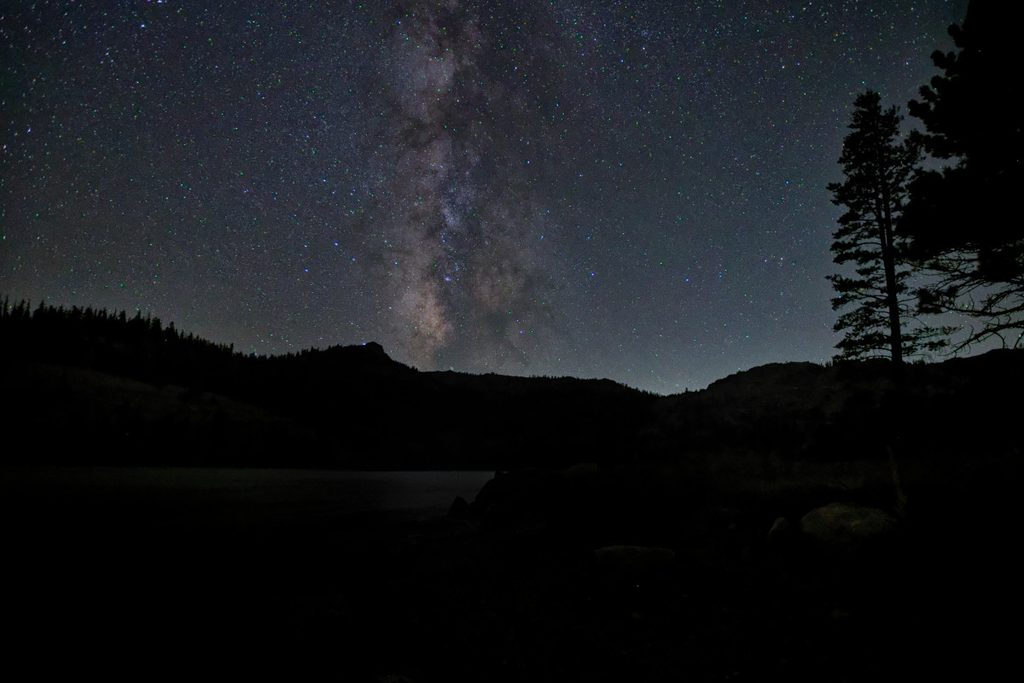
We found a shadowed spot at the overlook anyway and it was still good. The Milky Way came through clearly, I got a couple of shots I was happy with, and looking down at the water you could make out Fannette Island sitting in the middle of the bay, the only island in all of Lake Tahoe. The Pleiades were sharp low on the horizon and I could just barely pull Andromeda out of the sky. My camera also picked up airglow that I never noticed with my naked eye, which is always a slightly eerie thing to find later on the back of the screen.

To get a number that was not contaminated by those floodlights, we drove a little further down the road and metered from there. It came out at 21.10, which puts it in solid Bortle 4 territory. What sold me on this sky was not the number though. It was that the Milky Way was easy to see with almost no dark adaptation at all. I looked up and it was just there, with visible structure in it. That is not typical Bortle 4 behavior.
Given how high the Milky Way was riding in August, some of that brightness is going into the meter and pulling the number down. My read is that this is right on the 4 and 3 border, and on a night without a construction crew parked on the mountain it would likely tip over into 3.
If you only have one night and one drive in you, this is where I would send you. Bring a red flashlight, keep your headlights off once you are parked, and be courteous, because other people will be out here doing the same thing you are.

Red Lake, Carson Pass
Very clear skies, light wind early. Metered after the quarter moon dropped behind the ridge.
For the last night we wanted to know how much darker it gets if you leave the basin entirely. So we drove south and climbed into the mountains on Highway 88, out to a small lake called Red Lake at 7,864 feet (2,400 m), a bit under an hour from South Lake Tahoe.
This is a fascinating stretch of road. Red Lake sits just below the Devils Ladder, a brutal one mile wagon climb the 1849 emigrants had to haul themselves up to reach Carson Pass. The headwall gains 720 feet in a third of a mile, and pioneers roped their wagons to trees to keep them from rolling back down. Some of those old pines still carry the rope scars. The Pacific Crest Trail crosses right through here at the pass as well, so there is a lot of history stacked into a few miles.
You do not have to pick Red Lake specifically. There are pullouts and overlooks all along this route and most of them will give you a comparable sky. What I liked about our spot is that it sat off the road, so oncoming headlights and brake lights were simply not a factor. That is worth optimizing for.
The complication was the moon. We showed up with a quarter moon still hanging in the sky and knew it would not be dropping until around 11:20. So we waited. We took some readings while it was going down and watched the darkness climb, but the numbers do not mean much until the moon is fully below the horizon, so we hung out and waited it out.

Once it was gone, the first clean reading was 21.16 and I eventually got it up to 21.20. On the raw number alone that reads like a 4, but I am calling this a Bortle 3, and I am comfortable sitting it square in the middle of 3 rather than at the edge.
Here is my reasoning. The Milky Way was casting real light and showing far more detail than the number suggests, which is what happens when the core is sitting in the patch of sky you are metering. Andromeda was extremely clear, no work required. And I could not quite pull out the Triangulum Galaxy, which for me is the cue that separates a 3 from a 2. Naked eye markers like that tell you more about a sky than a single meter reading does.
The terrain deserves credit too. The ridgelines around Red Lake do a beautiful job of hiding the light domes, so there was very little glow affecting anything. The elevation gives you crisp, clean air. The wind was up when we arrived and then died off completely, and what was left was one of those nights that makes the whole drive feel like nothing.
The meteors were absurd. At one point we had three inside a minute or two. It felt like we had wandered into a shower, which surprised me because we were a week past the Perseid peak on 12 August. The Perseids do stay active until around the 24th though, so those green streaks were very likely still Perseids working through the tail of the shower. Several of them, bright, right across the sky.

Final word
Lake Tahoe has fantastic stargazing, and the useful thing is that it has it at every level of effort.
If you are staying in town and cannot get away, you will still see constellations, and from a hot tub with the lights off that is a genuinely good night. If you can drive twenty minutes, go to Emerald Bay. It is a strong Bortle 4 that behaves like a 3, and the view over the water is hard to beat. Our floodlight situation was just bad luck and should not put you off it.
And if you want something closer to pristine, leave the basin. Head south on Highway 88, or any of the other roads that climb out of the Tahoe area, and the sky gets noticeably darker. That is where the Milky Way stops being something you look for and starts being something you cannot look away from. To me, that is the whole experience.
Find the dark sky closest to you
What Tahoe really taught me is how steep the payoff curve is. We went from 19.56 in a parking garage to 21.20 at a mountain lake, and the difference in what your eyes can actually do under those two skies is enormous. That is less than an hour of driving.
Almost everywhere has a version of that drive. Wherever you live, there is very likely a sky worth the trip within a couple of hours of your front door. The hard part is not the distance. It is knowing which direction to point the car, and which night to go, because getting either one wrong is how most people end up standing outside in the cold seeing nothing.
I put together a free guide on how to find dark skies near you, including how to read a light pollution map without being fooled by it and how to work out the nights that are actually worth your time. Grab the guide here and go find yours.
Leave a Reply