This post contains affiliate links. As an Amazon Associate I earn from qualifying purchases. If you click a link and make a purchase, I may receive a small commission at no extra cost to you.
Imagine you’re a photon that’s been travelling for 2.5 million years.
You left the Andromeda Galaxy before our species existed. You crossed the intergalactic void at the speed of light, threading through the darkness for longer than the human mind can actually comprehend.
You survived every light-year of empty nothing and you’re now in the final fraction of a second of your journey, about to land in the eye of someone pointing a telescope at the sky.
And then… a gas station floodlight turns on. And suddenly, your ancient existence is drowned at the finish line.
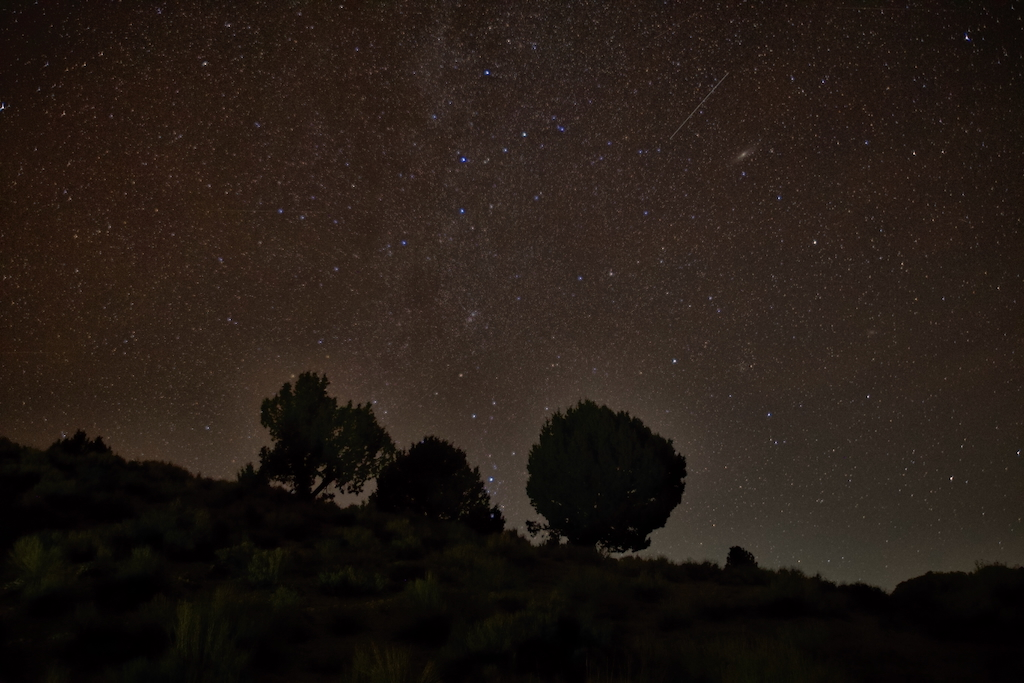
That’s light pollution for you. And it’s slowly stealing one of the most profound experiences a human being can have — from almost all of us.
According to the New World Atlas of Artificial Night Sky Brightness, more than 83% of the world’s population now lives under light-polluted skies. In the United States and Europe, 99% of people can’t experience a truly natural night.
We are the first generations in the history of the human species to grow up without a visual connection to the rest of the universe.
But before you give up on your backyard or assume you need to move to Montana, stick with me — because once you understand what light pollution actually is, you’ll know exactly how to fight it.
And you’ll know that some of the most jaw-dropping skies you’ll ever see might be closer than you think.

What Is Light Pollution, Really?
Light pollution is any artificial light that escapes into the sky where it isn’t needed and wasn’t intended — and it’s not just an annoyance for astronomers. It’s a measurable degradation of the night environment.
Most people think of light pollution as just “too many lights.” That’s part of it. The bigger issue is what happens to that light after it’s emitted.
When a streetlamp turns on, not all of its light goes where it’s intended — downward onto the road or sidewalk. Poorly shielded fixtures send a significant amount outward and upward, and even properly aimed light reflects back upward off pavement, buildings, and cars.
Once that light enters the atmosphere, it interacts with dust, water vapor, aerosols, smog, and even air molecules themselves. Those particles scatter the light in all directions, creating the orange or white dome that hangs over towns and cities. Astronomers call this Skyglow.
Because humidity, pollution, and atmospheric conditions vary by location, two cities emitting the same amount of light can produce very different levels of skyglow.
One thing that surprises many beginners is that light pollution doesn’t behave the same way in every direction.
Vertically, it’s somewhat limited because most atmospheric scattering happens in the troposphere. That’s the lowest layer of the atmosphere, extending roughly 5–9 miles above Earth’s surface. This is where the air is densest and where most water vapor and aerosols are concentrated. Above much of that layer, the sky becomes dramatically darker.
Horizontally, though, light pollution can travel crazy distances. The atmosphere is much thicker along the horizon than it is straight overhead, so scattered light keeps interacting with air, dust, and aerosols over a far longer path. Under the right conditions, the glow from a major city can be visible from more than 125–185 miles away.

Not All Light Is Man-Made
Here’s something that throws beginners off: the night sky has its own natural sources of light, and some of them are brighter than you’d expect.
The Moon is the big one.
A full moon pours so much light onto the landscape that it genuinely suppresses your ability to see faint objects. Your eyes never fully dark-adapt when the moon is up, because they keep being stimulated. Most serious observers plan their sessions around the lunar calendar — scheduling deep-sky work during the week or two around new moon, when the moon is either absent or rising and setting with the sun.

The Milky Way itself adds a soft, diffuse background glow to the sky. This isn’t a problem because it’s one of the most stunning sights you’ll ever see. But it does mean that even under perfect, pristine skies, there’s a natural background brightness that sets a floor on how faint you can see.
Zodiacal light is one that most beginners have never heard of, and it often looks like light pollution the first time you see it. It’s a faint, pyramid-shaped cone of light that stretches up from the horizon along the ecliptic — the path the planets follow — and it’s caused by sunlight reflecting off dust spread throughout the solar system.
Under dark enough skies, it can be dramatic. People see it and panic that there’s a city hidden behind the hill. There isn’t. That’s just our solar system being beautiful.
Airglow (not to be confused with sky glow) is stranger still.
Even if you turned off every single light on Earth and waited for a moonless night, the sky would still glow. During the day, solar radiation charges up atoms in the upper atmosphere. At night, those atoms release that stored energy as a faint light — a process called chemiluminescence.
Under the very darkest Bortle 1 skies, you can actually see it: a subtle, greenish shimmer that gives the horizon an almost otherworldly quality. It’s the atmosphere itself breathing.
None of these natural sources are enemies. But they’re variables to be aware of, because they affect what you can and can’t see on any given night — regardless of what’s happening with the lights down here on Earth.
Bortle Zones: Know Before You Go
The single most useful concept for getting a handle on light pollution is the Bortle scale.
It’s a nine-point rating system that runs from Bortle 1 (the most pristine, untouched dark sky on Earth) to Bortle 9 (the centre of a brightly lit city, where you might see the Moon, a handful of planets, and essentially nothing else).
Most suburban backyards fall in the Bortle 5–7 range. Many urban observers are at 8 or 9. But genuinely dark (Bortle 3-4 and below) skies often exist within reasonable driving distance of major population centers.
The good news is that mapping these zones isn’t guesswork.
There are detailed light pollution maps that show you exactly what the sky quality is in any location on Earth. Well, they’re not always 100% accurate but generally pretty close.
Once you know what you’re looking for, planning a dark-sky drive is completely achievable — even for a complete beginner.
(We put together a full guide on reading Bortle zones and using light pollution maps to find dark skies near you — it’s worth the read before your next outing.)
Filtering Out the Noise
You can’t control what your city does, but you can absolutely stack the deck in your favor.
One way to do this is with light pollution filters. They don’t make light pollution disappear, but they block out specific wavelengths of light — like the orange of sodium lamps — while letting through the wavelengths that nebulae and other objects actually emit.
There’s a major caveat for using light pollution filters, though.
The shift to white LED streetlights — which has been happening rapidly over the last decade — has actually made things harder for filter users. Old sodium lamps emitted most of their light in a narrow band of orange wavelengths, which filters could cut cleanly. LEDs emit across a much broader spectrum, including a lot of blue light. And blue light scatters far more aggressively in the atmosphere — a phenomenon called Rayleigh scattering (which is the same reason the daytime sky is blue).
The result is a modern skyglow that’s broader, noisier, and harder to filter than anything astronomers dealt with twenty years ago. It doesn’t make filters useless. It just means you need to go in with realistic expectations.
Still, lots of people in light polluted areas benefit from narrowband filters like the UHC or OIII. They pass only very specific wavelengths of light, typically those emitted by ionized gases in nebulae. For emission nebulae in particular, like the Orion Nebula or the Lagoon, a narrowband filter can pull targets out of a washed-out sky that would otherwise hide them completely.
Dealing with stray light
Stray light is a separate problem — and it’s more annoying than people expect.
If there’s a streetlamp down the road, a neighbor’s porch light, or a lit-up window behind you, your eyes are constantly being blasted with direct light that kills your dark adaptation. A few practical fixes:
- Use your telescope’s dew shield (or add one) to block light coming in from the sides at low angles.
- Use the eyecup on your eyepiece properly — press your eye gently against it to physically seal out ambient light.
- Cup your hands around the eyepiece barrel if you don’t have a good eyecup. It sounds trivial; it makes a surprising difference.
- Position yourself so that your body is between the light source and your eye. Use a wall, your car, a hedge — anything that creates a shadow around your viewing position.
- Give your eyes time. Full dark adaptation takes around 30 minutes of absolutely no white light exposure. Red lights don’t count — use red-light torches for any reading or map work. Even a two-second glance at your phone screen will set you back significantly.
None of this costs money. It’s just habit. And the difference between a half-adapted eye and a fully dark-adapted one is like looking at the sky through dirty glass versus clean.
Get Started in Astronomy
If this has you fired up to get out under a dark sky, the next step is making sure you have the right telescope to bring with you. Not sure where to start? I put together a free PDF telescope cheat sheet that breaks down exactly which scope might be right for you, the specs that actually matter, and how to figure out your budget. Grab it — it’ll save you a lot of second-guessing before your first real dark sky night.