This post contains affiliate links. As an Amazon Associate I earn from qualifying purchases. If you click a link and make a purchase, I may receive a small commission at no extra cost to you.
I finally got my first chance to take the SeeStar S30 Pro out for a proper run — and the conditions were far from ideal. Bortle 7 suburban skies, very humid, a few clouds drifting through. Very different from the Arizona conditions I’m familiar with.
I set it up anyway. Because the only way to find out what a scope is actually capable of is to put it under a real sky and see how it goes.
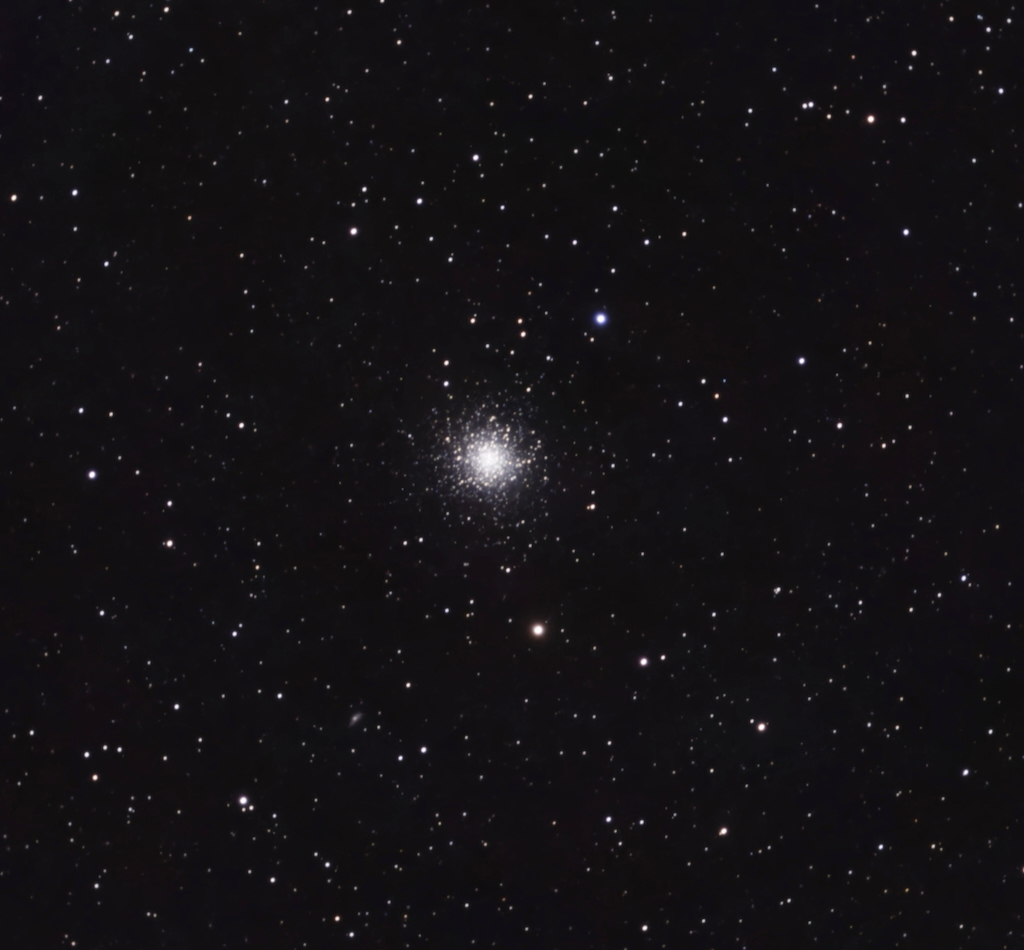
So here’s what the SeeStar S30 Pro pulled out of a fairly light-polluted suburban night, pointed at M13, the Great Globular Cluster in Hercules.
Photo details
- Object: M13 (Great Globular Cluster in Hercules)
- Constellation: Hercules
- Bortle: 7
- Exposure time: 10 seconds
- Duration: 39 Minutes
- Other: Light pollution filter on


Field Notes
A few things I learned on my very first outing.
The first lesson is pretty huge.
The total stacking time doesn’t line up with how long the telescope is actually outside collecting light.
I first spent a good chunk of the night pointed at M51, but despite leaving it running for four hours, I only ended up with about 75 minutes of actual exposure time. When I checked on it, I kept seeing this message:
“Stacking failed. Star trails detected. Image discarded.”
My best guess is that the clouds rolling through were thick enough to throw off the star detection. Something to investigate before the next session.
By the time I swung over to M13, I had about a quarter of a battery left and wasn’t sure what to expect. It still managed 39 minutes of stacked exposure — and honestly, for a target as bright as M13, that turned out to be plenty. Detail was already showing up after the first two frames came in.
The real surprise was a tiny spiral galaxy lurking in the lower left of the frame. I’m fairly confident that’s NGC 6207, which sits at magnitude 11.65. The fact that it showed up at all — in Bortle 7 skies, on a cloudy night, with under 40 minutes of exposure — says something about what this scope can do.
It makes me wonder what could be possible with even more exposure time.
Processing
For this first session I kept it simple and processed everything natively in the app. My goal was to get a feel for the equipment rather than dive into a full post-processing workflow.
The built-in tools handled M13 well — I used the AI denoise feature, dialed in some contrast to deepen the background, and was genuinely surprised by how little effort it took to get a result I was happy with.
If you’re looking for an easy win when first trying out the SeeStar S30 Pro for astrophotography this is a fantastic target.
Final Word
Overall, a really encouraging first outing.
Setup was quick and painless, the scope found its targets without any fuss, and even under compromised conditions it delivered results worth sharing. The star trail issue is the one thing I want to dig into — I suspect the clouds were the main culprit, but I’ll know more after a cleaner night.
One thing this session confirmed: I’m a visual astronomer first. There’s something about putting your eye to the eyepiece that no image on a screen fully replaces. But this is a different kind of experience — and a genuinely great one. Being able to pull a processed image off a dark sky session and share it with someone who’s never looked through a telescope before? That’s its own kind of reward, and it’s exactly the kind of thing I want to do more of.