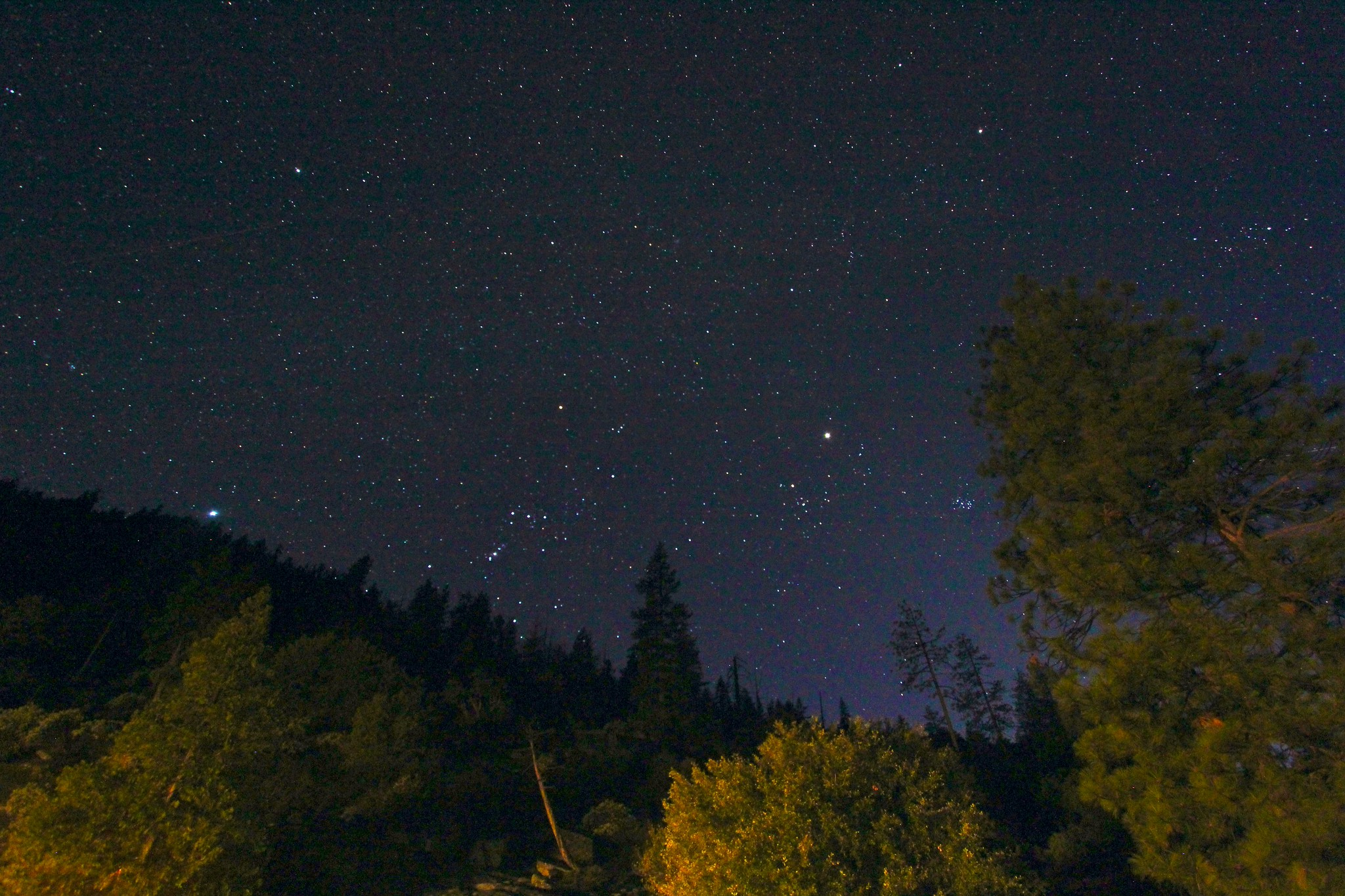
This post contains affiliate links. As an Amazon Associate I earn from qualifying purchases. If you click a link and make a purchase, I may receive a small commission at no extra cost to you.
When I ask someone what constellations they know, they almost always begin by mentioning the Big Dipper.
It’s good that people have an idea of what’s up there in a night sky.
The only problem is, the Big Dipper is not a constellation.
(Don’t feel bad if you also thought the Dig Dipper was a constellation — it trips up a lot of people.)
But that misconception is a perfect place to start. Because once you understand what a constellation actually is, the whole night sky starts to make a lot more sense.
It’s Not Just the Lines
When most people picture a constellation, they picture dots of light connected by imaginary lines — like some kind of celestial dot-to-dot puzzle. And sure, those patterns are part of it. But a constellation is actually much bigger than that.
Think of it like this: the United States isn’t just its cities connected by highways. It’s also all the land, fields, and forests between them. The state borders, however arbitrary they may be, are what make up the entire country.
Constellations work the same way.
A constellation is a region of the sky — a mapped-out patch with defined boundaries, not just a connect-the-dots pattern floating in space.
Every single point of sky you can see belongs to a constellation. Stars, galaxies, nebulae, the faint smudges you can barely make out — all of it falls within the boundary of one constellation or another.

So back to the Big Dipper… if it’s not a constellation then what is it?
It’s an asterism — an unofficial star pattern that’s part of a larger constellation called Ursa Major, the Great Bear. The Dipper is just the bear’s back and tail. The rest of the bear is out there too, hiding in plain sight.

There are quite a few asterism’s out there and learning them is a great way to learn the night sky, but it’s always worth remembering that they are not actually the constellations.

88 Official Territories in the Sky
For centuries, different cultures all over the world looked up at the same stars and saw completely different things.
The Greeks saw heroes and monsters. Indigenous peoples of the Americas traced animals and ancestors. Polynesian navigators used the stars as a roadmap across the open ocean. Chinese astronomers divided the sky into their own intricate system of asterisms, often linked to imperial courts and seasonal farming.
Nobody agreed on the rules. The sky was a beautiful, gloriously messy patchwork of stories.
In 1922, the International Astronomical Union stepped in and agreed on a standardized list of 88 constellation names — settling, once and for all, which constellations would officially exist.
Eight years later, Belgian astronomer Eugène Delporte did the painstaking follow-up work: drawing the precise boundaries that turned those names into territories. No overlaps. No gaps. Every part of the sky belongs to exactly one constellation.
Those 88 constellations carry names and shapes passed down through history — mostly from the Greco-Roman tradition — but now every astronomer and telescope on earth uses the same map.
The Stories Are the Secret
Here’s the thing nobody tells you when you’re first learning the night sky: charts and star maps are useful, but they’re not what makes it stick.
The stories are what make it stick.
When you know that Orion the Hunter is frozen mid-battle in the sky, you start noticing him everywhere in the winter sky. When you know Scorpius the Scorpion is on the opposite side of the sky from Orion — because the myth says they can never be in the sky at the same time — suddenly you have a relationship that tells you something real and useful about the seasons.
When you know that Cassiopeia — that distinctive W shape in the northern sky — is a vain queen who boasted that her daughter Andromeda was more beautiful than the sea nymphs, and that her husband King Cepheus was forced to chain Andromeda to a rock as a sacrifice to a sea monster to appease the gods, you realize that… stories from back in the day were… often as absurd as they get.
The good news is that you don’t have to believe the stories. You just have to learn them.
Because a good/crazy story is a memory hook, and memory hooks are exactly what you need when you’re standing outside in the dark trying to figure out which smudge of stars is which.
The Only Real Way to Learn Them
Books help. Star charts help. Apps help, though I’ll be honest — staring at your phone screen every time you look up will slow you down more than speed you up.
But there is only one way to actually learn the night sky, and that’s to get outside under it.
Start with the big, obvious patterns. Learn a few of the relationships — how the pointer stars of the Big Dipper lead you straight to Polaris, the North Star. How Orion’s Belt stretches southeast toward Sirius, the brightest star in the sky. How following that same belt northwest brings you up to Aldebaran and the Hyades star cluster in Taurus.
These chains of relationships are the skeleton of the sky. Once you know them, they pull everything else into place. You stop searching and start recognizing.
And then one night you’ll be standing outside and you’ll realize you’re not looking things up anymore. You’ll just know where you are. You’ll sweep your telescope across the sky and find an old galaxy without checking a chart, because you remember it’s just a little northeast of that bright star, in the middle of that constellation you learned three months ago.
It’s a pretty incredible feeling.
Get Started in Astronomy
If this has you fired up to get out under a dark sky, the next step might be making sure you have the right telescope with you when you go. Not sure where to start?
I put together a free PDF telescope cheat sheet that breaks down which scope might be right for you, the specs that actually matter, and how to think through your budget. Grab it — it’ll save you a lot of second-guessing before your first real night out.