This post contains affiliate links. As an Amazon Associate I earn from qualifying purchases. If you click a link and make a purchase, I may receive a small commission at no extra cost to you.
Key takeaways
- Austin has one of the shortest drives from a bright city sky to a genuinely good one that I have measured anywhere. Half an hour west and the Milky Way is back, with detail in it.
- Downtown at Vic Mathias Shores read 17.40. The number says Bortle 9, but I could pick out the Summer Triangle and the Big Dipper without working for it, so I am calling it an 8.
- Bee Cave came in at 18.94, a Bortle 6, only about 15 miles (24 km) out. Constellations are easy there and we pulled a faint Milky Way on an iPhone.
- Milton Reimers Ranch Park was the one worth the drive at 20.51, an honest Bortle 4 with a structured Milky Way, and it has a public observatory with a 25-inch telescope in it.
New to the numbers? The Bortle scale runs from 1, the darkest skies left on Earth, to 9, an inner city where the constellations disappear. Sky brightness is measured in mag/arcsec², where a higher number means a darker sky. A Bortle 4 is where the Milky Way becomes obvious again, clearly visible well above the horizon, even if the faintest structure in it is still washed out.
Introduction
Austin stargazing is a strange thing to write about, because Austin has a problem most cities its size do not get to have: too many good options. The Hill Country starts more or less at the western edge of town, and a string of communities out there have actually written and enforced outdoor lighting ordinances. So the darkness does not just improve with distance the way it does everywhere else. It improves because somebody did the policy work.
Head west on 290 and you have Pedernales Falls State Park, Johnson City, and Stonewall, where Lyndon B. Johnson National Historical Park has been a certified Dark Sky Park since 2021. Go southwest and you are in Wimberley Valley, a Dark Sky Community since 2018, with Old Baldy waiting if you want to earn your view with a staircase. Push further west, about 95 miles (153 km), and you reach Enchanted Rock, a Dark Sky Park since 2014 and the closest thing to a marquee site in the region. Northwest, there is Jonestown near Lake Travis and Inks Lake State Park at roughly 65 miles (105 km).
That is a lot of ground, and I will get back to most of it. For this trip I wanted to answer a narrower question: how quickly does it actually get dark once you leave downtown? So we ran a straight line west over two nights in July, starting in the middle of the city and stopping twice. Here is what the meter said.

Want to experience the awe and beauty of being under a truly dark sky?
Get expert help putting together a life-changing night under the stars: the ultimate astro vacation.
Plan my tripTesting Austin stargazing sites for light pollution
Downtown Austin, Vic Mathias Shores
Clear skies. Two readings, 17.35 and 17.40, taken as soon as true darkness set in. Metered from the south shore of Lady Bird Lake, within about 3,000 feet (900 m) of the skyline.
We set up at Vic Mathias Shores, on the south shore of Lady Bird Lake looking straight across at downtown. That spot is not an accident. When I take a city baseline, I try to get within about 3,000 feet (900 m) of the edge of the skyline. Any closer and you are just measuring a specific streetlight. Much further and you are quietly measuring the suburbs and calling it downtown. Vic Mathias Shores lands almost exactly in that window, with open sky overhead and the towers right there in front of you.
We waited for true darkness and took two readings: 17.35, then 17.40. On the number alone that is a Bortle 9, the bottom of the scale.
I do not think that is right, and this is the part of the night I found most interesting. I looked up and could see plenty of stars. The Summer Triangle was obvious. The Big Dipper took no effort at all. That is not Bortle 9 behavior. A Class 9 sky is one where most of the stars that make up a constellation are simply gone and people stop looking up entirely. What I was standing under was a Class 8, and I am comfortable saying so.
This is the second time the meter and my eyes have disagreed, and it is worth understanding why it happens in both directions. Out at a dark site, a high Milky Way pours light into the sensor and pushes the number brighter than the sky deserves. In a city, the meter is reading a wash of diffuse glow that your eyes are much better at seeing past than a sensor is. The number is a measurement. The Bortle class is a description of what a person can actually see. When they disagree, I go with the description and show you the number so you can argue with me.
For context, this is a considerably better city sky than I have measured elsewhere. Downtown Houston came in at 16.42 and I found exactly one star. Austin at 17.40, this close to the skyline, is honestly not bad.

Bee Cave
Clear skies, same night as the downtown reading. Faint Milky Way captured on an iPhone.
Straight after downtown we drove about 30 minutes west, roughly 15 miles (24 km), to Bee Cave. This was our first dark sky stop of the trip and the reason I picked it is the designation. Bee Cave was certified as an International Dark Sky Community in 2023, the seventh in Texas, which means the city took real measures to cut its light pollution rather than just happening to sit far from a freeway.
The meter gave us 18.94, which puts it in a nice Bortle 6. Not bad at all for somewhere that is still, by any honest description, part of the Austin metro. Constellations came easily, there were a lot more stars than downtown, which is no surprise, and we picked up a very faint Milky Way with the iPhone.
Sit with that for a second, because it is the whole point of the trip. Fifteen miles of driving bought two full Bortle classes. In most metros of this size, fifteen miles buys you almost nothing, because there is no reason for the suburb you land in to light itself any differently than the city did. Bee Cave is different because Bee Cave decided to be.
If you live in Austin and you have an hour on a weeknight rather than a whole evening, this is the tier you should know about. It is not a photography sky. It is a walk outside and actually see something sky, and it is close enough that you will really go.

Milton Reimers Ranch Park
Clear skies. Austin’s light dome still visible low on the eastern side.
Bee Cave was good, but we wanted more, so the next night we drove another 20 minutes west, about 14 miles (23 km) further out on Hamilton Pool Road, to Milton Reimers Ranch Park. Travis County runs it, and it has been a certified International Dark Sky Park since 2021.
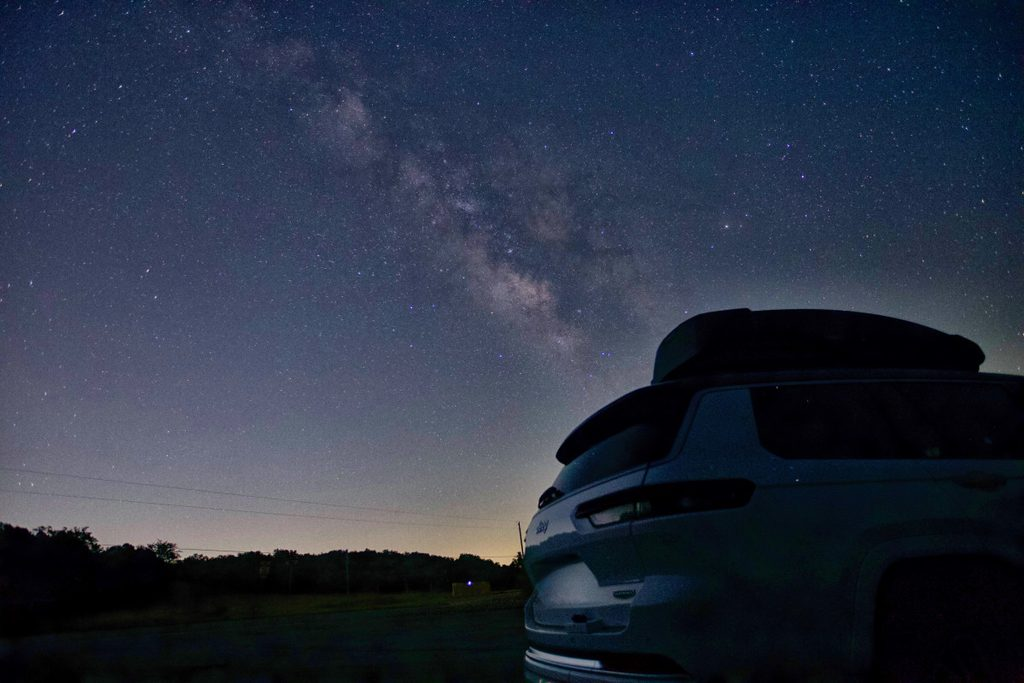
The first reading came back at 20.51. That is a legitimate Bortle 4, and you can tell without the meter, which is always the better confirmation. The Milky Way was up and there was real detail running along the middle of it. My eyes only needed to adjust a little to start pulling that structure out, and it stayed visible rather than coming and going.
What makes that number more impressive than it looks is what is sitting on the eastern horizon. Austin’s light dome is right there, and you can see it. A Bortle 4 with a metro of well over two million glowing off one shoulder is a genuinely good result, and it says something about the lighting ordinances between here and there.

The thing that makes me recommend this park over anywhere else on this list, though, is the observatory. Reimers Observatory sits inside the park and it is open to the public, with a 25-inch and a 15-inch telescope. That is serious aperture, the kind most people never get to look through, and you do not have to own any of it or know how to drive it. Programs run most weekends outside of the nights around full moon and you reserve through Travis County Parks. Book ahead, because it fills.
So you get a real Bortle 4 sky, a Milky Way with structure in it, and a big telescope pointed at whatever is worth seeing that night. Half an hour from Bee Cave, under an hour from downtown.

Final word
Austin’s gradient is short and steep, and that is unusual. We went 17.40 downtown, 18.94 fifteen miles out, 20.51 thirty miles out. Four Bortle classes inside a single county.
Pick your tier by how much time you have. Downtown will give you the bright constellations and the planets, which is a perfectly nice thing to do with twenty minutes and a lawn. Bee Cave is the weeknight answer, close enough that you will actually leave the house. Reimers Ranch is where you go when you want the Milky Way, and the observatory makes it the best value night in the region by a distance.
And if you want darker still, keep driving. Enchanted Rock, the LBJ park units around Stonewall and Johnson City, Pedernales Falls, Inks Lake, Wimberley. I will get out to those and measure them properly. But the honest headline from this trip is that you do not have to. Thirty minutes west of a state capital, the Milky Way has structure in it. That should not be normal, and in most of the country it is not.
Find the dark sky closest to you
The reason Austin works is not geography. It is that a handful of towns west of the city wrote lighting rules and stuck to them, and you can measure the difference from the passenger seat. That is worth knowing wherever you live, because it means the good sky near you is often much closer than the maps suggest, sitting just past whichever town decided to point its lights at the ground.
Finding it is mostly a matter of knowing what to look for. Which direction to drive, how to read a light pollution map without being fooled by it, and how to pick the nights that are actually worth your time, because getting the night wrong is how most people end up standing in a field seeing nothing.
I put all of that into a free guide. Grab it here and go find yours.
Leave a Reply