This post contains affiliate links. As an Amazon Associate I earn from qualifying purchases. If you click a link and make a purchase, I may receive a small commission at no extra cost to you.
Before we get into who these telescopes are and aren’t for, it’s worth explaining what we actually mean by a smart telescope, because the term gets used in a few different ways.
At the broadest level, it can refer to any telescope that uses technology to assist with finding or tracking objects.
But increasingly, the term is being used to describe a specific type of beginner-friendly telescope that lets you capture photos and videos of celestial objects — including deep sky objects like galaxies and nebulae — almost entirely automatically.
You open an app, select a target, press a button, and the telescope finds it and starts imaging.
It feels like magic: the scope continuously stacks exposures in real-time, building up an ever-clearer image on your phone as you watch. The app handles the processing, and you end up with a shareable photo in minutes.
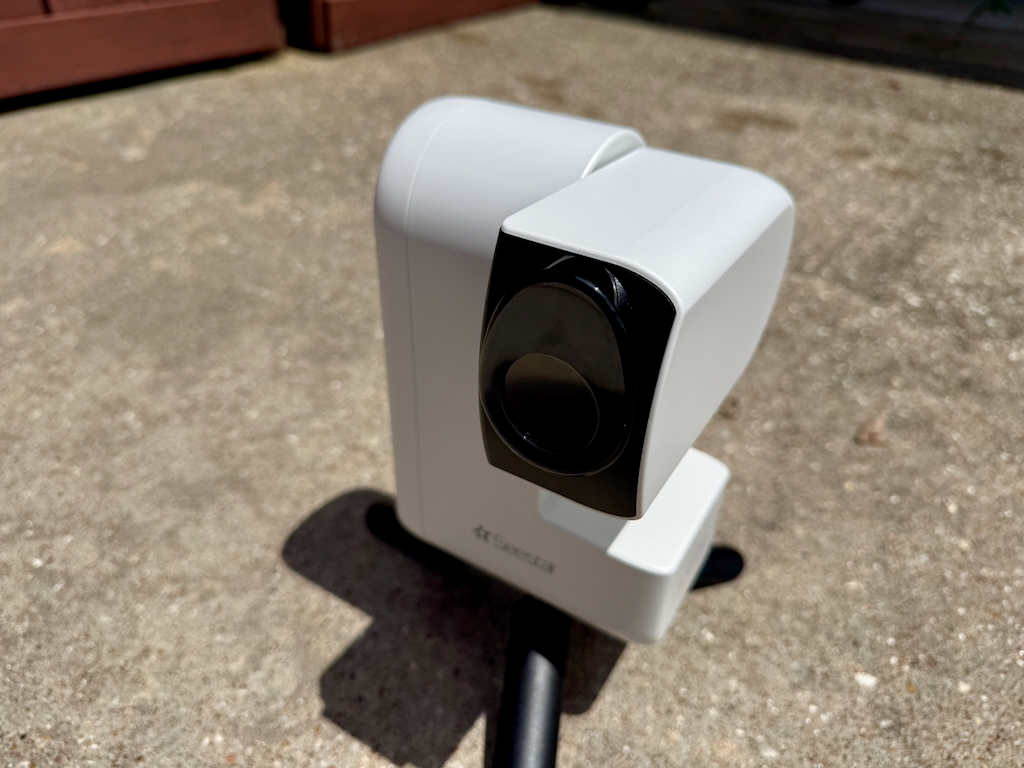
The one I use is the Seestar S30 Pro, which sits at the more accessible end of the price range ($699).
But there are other options worth knowing about — the Vaonis Vespera II ($1,600) is a popular mid-range pick, and at the premium end, the Unistellar eVscope 2 ($5,400) offers a larger aperture and higher resolution camera for a significantly higher price.
Who Smart Telescopes Are Really For
Aspiring astronomers in light-polluted areas
If you’re a beginner living in a light-polluted area, reading about and seeing deep sky objects can be a little discouraging.
It can be hard to get a good look at many of these objects, leaving you wondering what they’d really look like under a dark sky. That FOMO like experience can kill some of the joy and excitement of getting into the hobby.
A smart telescope can work through pretty significant light pollution and still pull out impressive detail. A big part of why is that many of these scopes have built-in dual-band filters — hardware designed specifically to cut through skyglow and isolate the wavelengths where nebulae and galaxies actually emit light. It’s not just software doing the heavy lifting.
Take a look at this shot I got of M13 under a Bortle 7 sky. You would never gues there’s substantial light pollution where this was taken.

So if you’re in a urban area or a highly polluted suburban area, a smart telescope can be a fantastic way to break through the light pollution and start to discover some pretty amazing deep sky objects.
People who want to get into astrophotography
These telescopes are a great way to get into astrophotography.
For one, it’s extremely easy to capture cool-looking images of deep sky objects. The app handles the stacking and even noise removal, so you become an instant “astrophotographer” and end up with something worth sharing from day one.
Yes, many of these models are still going to be a significant step down from what you would be able to get with more robust set up. But for one, those set ups can cost you a few thousand dollars, which is significantly more than something like the SeeStar S30 Pro.
The other thing worth mentioning is that you also have the option of using smart telescope images in your own workflow. You could go out multiple nights shooting the same object, building up hours of data that you then process yourself with PixInsight, Siril, GraXpert, etc.
This can help your images stand out with much higher quality then what you get when you process the images natively inside the smart telescope app.
But honestly, the biggest perk is probably that smart telescopes help you get familiar with the different steps, sequences, and software — which is absolutely vital in astrophotography.
They let you focus on the processing side of things, and when you’re ready to upgrade your gear (if you ever even want to), you won’t have to tackle both learning curves at the same time.
People with physical limitations
Smart telescopes are controlled entirely from your phone — no bending over an eyepiece, no manual tracking, and minimal physical setup. For anyone with mobility issues, arthritis, or a bad back, that’s a meaningful advantage over a traditional setup. It opens the hobby up to people who might otherwise find it difficult or impossible to use a conventional telescope.
Who These Telescopes May Not Be the Best For
Budget-conscious beginners
Smart telescopes often sit at a higher price point than a basic refractor or Dobsonian. If you just want to dip a toe into astronomy without a big investment, you can get a capable visual telescope for cheaper.
And if you want to begin your astronomy journey with binoculars, you can also do that with substantially less money spent.
If price is a concern, this probably isn’t the best entry point into the hobby.
People who want a visual connection with the night sky
These telescopes aren’t the best fit for people who want to connect with the night sky in a visual way. That’s my preferred way to connect — finding galaxies and nebulae by star hopping, viewing them through a large reflector telescope, and just embracing the moment under the night sky. For me, nothing really comes close to that.
Being hands-on with a telescope is also a great way just to learn astronomy because you get better with star charts, Barlow lenses, eyepieces, filters, focus, and a lot of other fundamental things that will benefit you and quite frankly make you more of a “real astronomer.”
Now, don’t get me wrong. I really like being able to capture images, especially for my content, because it makes it so much easier to talk about these objects.
And there is something special about having your own image of a galaxy or nebula, one that has a personal connection to the place and time where you captured it. And who knows, you might even catch a supernova one day.
A smart telescope could also be a great way to get you interested in the hobby and motivated to learn more about deep sky objects. So from that angle, I think it can be a very good thing.
My worry is that some people might get one of these, take some photos, see a few cool things, and never really experience what it feels like to find these objects with their own eyes.
To me, that’s the real magic of astronomy. I realize it’s not for everybody, but I’d hate for anyone to miss it.

Get Started in Astronomy
If this has you fired up to get out under the night sky — whether with a smart telescope or something more traditional — the next step is making sure you have the right gear to start with.
Not sure where to begin? I put together a free PDF telescope cheat sheet that breaks down exactly which scope might be right for you, the specs that actually matter, and how to figure out your budget. Grab it — it’ll save you a lot of second-guessing before your first night out.