This post contains affiliate links. As an Amazon Associate I earn from qualifying purchases. If you click a link and make a purchase, I may receive a small commission at no extra cost to you.
Key takeaways
- Lassen Volcanic is about as dark as the night sky gets in California, and it is dark almost everywhere inside the park. Three sites, two nights, all within 0.05 mag/arcsec² of each other.
- Manzanita Lake was the darkest at 21.45, and it is also the easiest place in the park to reach. The number understates it, because an August Milky Way brightens the reading itself.
- Bumpass Hell trailhead sits at about 8,200 feet (2,500 m) with an enormous view, but headlight traffic makes it a poor choice for photography.
- Devastation Area was a highlight with a great view of the Milky Way over Lassen Peak
New to the numbers? The Bortle scale runs from 1, the darkest skies left on Earth, to 9, an inner city where the constellations disappear. Sky brightness is measured in mag/arcsec², where a higher number means a darker sky. A Bortle 2 is a genuinely dark site, dark enough that your surroundings show only as silhouettes against the sky.
Introduction
Lassen Volcanic National Park had been on my list for a very long time. I have always thought of it as one of the hidden gems of the national park system, and I also knew it sat in one of the darkest pockets left in California.
So when we kicked off the California light pollution measuring campaign, Lassen was not a hard choice for the first stop. With it being August, I was excited, not just for the Milky Way, but also for the cool temperatures at the higher elevations. Perfect hoodie and pants weather.
We spent two nights in the park and tested three different sites for its stargazing potential. Here is what we got.

Want to experience the awe and beauty of being under a truly dark sky?
Get expert help putting together a life-changing night under the stars: the ultimate astro vacation.
Plan my tripTesting Lassen stargazing sites for light pollution
Manzanita Lake
Very clear skies. No moon.
The first place we went was Manzanita Lake, and it is a very accessible stargazing spot in the park. It sits directly after the north entrance, close to the Loomis Museum and the rest of the facilities up there, so you are not making any kind of expedition out of it.
The Manzanita Lake Trail circles the water. We parked on the side of Lassen Peak Highway and hiked a little over half a mile, about 0.8 km, out to the Lassen Peak Vista Point, which is one of the primary overlooks on the lake. That short walk is worth doing. It puts real distance between you and the road, even though traffic up there was pretty minimal anyway.
We had the place to ourselves apart from one couple who stumbled onto us and went straight for their white flashlights without a second thought. Other than that, this is a great spot for solitude and for stargazing.

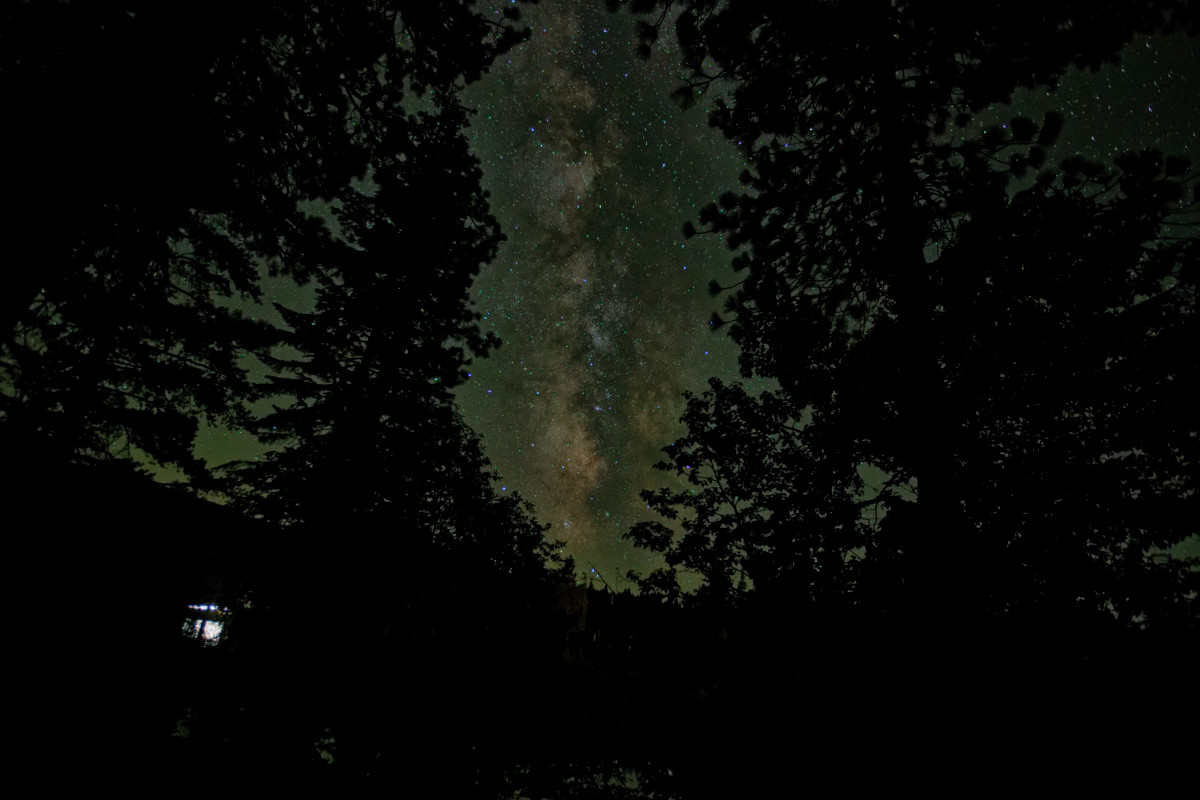
The skies here are pretty phenomenal. My reading came out to 21.45, which on paper would put you in Bortle 3 territory. But this was August, with the Milky Way out in peak fashion and sitting right in the part of the sky I was metering.
The core itself adds brightness to the reading, and my estimate is that it is worth 0.3 mag/arcsec² or more. Account for that and the true baseline of this sky is darker than the number suggests, which puts it at a solid Bortle 2 and possibly creeping toward Bortle 1.
I kept it at 2 because I never saw the Milky Way cast a shadow, and that is the giveaway for a genuine Class 1. But it is an extremely impressive sky either way. The Milky Way here starts to pop before your eyes have even adjusted, and for me that has always been the marker of a truly pristine sky.
We were also just past the peak of the Perseids, so meteors were still flying through the whole time we were out. It was a sight to behold.
Bumpass Hell Trailhead
Very clear skies. No moon.
The next night we made it out to the Bumpass Hell trailhead, which is one of the highest elevation points in the park at roughly 8,200 feet, or 2,500 m. It is signed off the main park highway with a parking area right there, so there is no hiking involved in getting to your stargazing site. That convenience is a large part of the problem, as it turns out.
It is a really cool spot because of the height. You get a panoramic view out into genuine vastness, although you do start to pick up on the light domes that are way out there on the horizon.
The hardest part is that this is a higher traffic area. You get vehicles pulling in with their headlights on and other people moving around with bright lights. For astrophotography or time lapses that is a real problem, and I could not get a clean run because of the disruptions.
For stargazing it is workable if you close your eyes when a car swings through and stay diligent about stray light, but for my liking it is just a little too busy. Go on a weeknight if you can, because everything wrong with this spot is other cars.
None of that is the sky’s fault. It was still extremely impressive and registered 21.40, which is a rounding error away from what I got down at the lake. Check the road status before you drive up here, too. The highway through the park closes with snow and the season is shorter than people expect at this elevation.

Devastation Area
Very clear skies. No moon.
I chose Devastation Area for our next stop because it sits in the middle of the park. I figured that being further from any edge might put more distance between me and the light pollution, and that I might finally get a darker reading than the other two stargazing sites. It has its own signed pullout and trailhead parking on the main park road, so like Bumpass you can step out of the car and be under it.
We pulled in and once again had extremely minimal traffic, maybe just a few cars over the span of a little more than an hour. It was a really cool site to stand in, with the Milky Way over Lassen Peak. I thought it was a great place.
The reading came out to 21.40, so essentially the same brightness as everywhere else, which was the interesting part. I suspect that if I got out to the cinder cones or somewhere a little more remote I might be able to pull a darker number, but either way this sky was just extremely dark all across the park.
I loved it here. You get a big view, a quiet pullout, and Lassen Peak sitting under the Milky Way.

Final word
I think this has to be one of the best national parks in the country for stargazing.
There are a lot of accessible trailheads, and that matters more than people give it credit for. You do not need a high clearance vehicle or a long approach to get somewhere genuinely dark here. The remoteness of the park keeps traffic pretty minimal at night, and it is worth saying that this was a weekend in August, which is as busy as Lassen gets. The elevation puts you above a good chunk of the atmosphere, which buys you cleaner, steadier viewing than the same sky would give you at sea level.
So yes, you do have to deal with some traffic. But it is very minimal, and for the most part it is easy to remove yourself from. This is an extremely impressive Bortle 2 sky, and under the right conditions I think it could be a Bortle 1.
Find the dark sky closest to you
The thing that stuck with me about Lassen is how little work it took. Half a mile of walking from a paved road and we were standing under one of the darkest skies in California, on a weekend, in peak season.
That is more common than most people think. Wherever you live, there is almost certainly a sky worth driving to within a few hours of your front door. The hard part is not the distance. It is knowing which direction to point the car, and which night to go, because getting either one wrong is how most people end up standing outside in the cold seeing nothing.
I put together a free guide on how to find dark skies near you, including how to read a light pollution map without being fooled by it and how to work out the nights that are actually worth your time. Grab the guide here and go find yours.
Leave a Reply