This post contains affiliate links. As an Amazon Associate I earn from qualifying purchases. If you click a link and make a purchase, I may receive a small commission at no extra cost to you.
Most beginners spend a lot of time learning what to look for in the night sky. Far fewer take the time to understand how big things actually are up there (or at least how big they appear).
Arc seconds, arc minutes, and degrees are how astronomers measure angular size and angular distance in the sky.
You’re not measuring how many miles wide a galaxy is. You’re measuring how much of your field of view it takes up from where you’re standing on Earth.
That distinction matters, and it’s what makes this system so practically useful at the eyepiece.
The System, Broken Down
Think of the entire sky as a giant sphere surrounding you. That sphere can be divided into 360 degrees, just like any circle.
One degree is a fairly large chunk of sky. The full Moon, for reference, is about half a degree wide (roughly 30 arcminutes). Most people are surprised by that. It looks bigger than it is.
One degree contains 60 arc minutes. So when astronomers say an object is 90 arcminutes across, they mean it spans one and a half degrees of sky.
One arc minute contains 60 arc seconds. Arc seconds are tiny. We’re talking about the scale at which planetary discs, double star separations, and fine detail live.
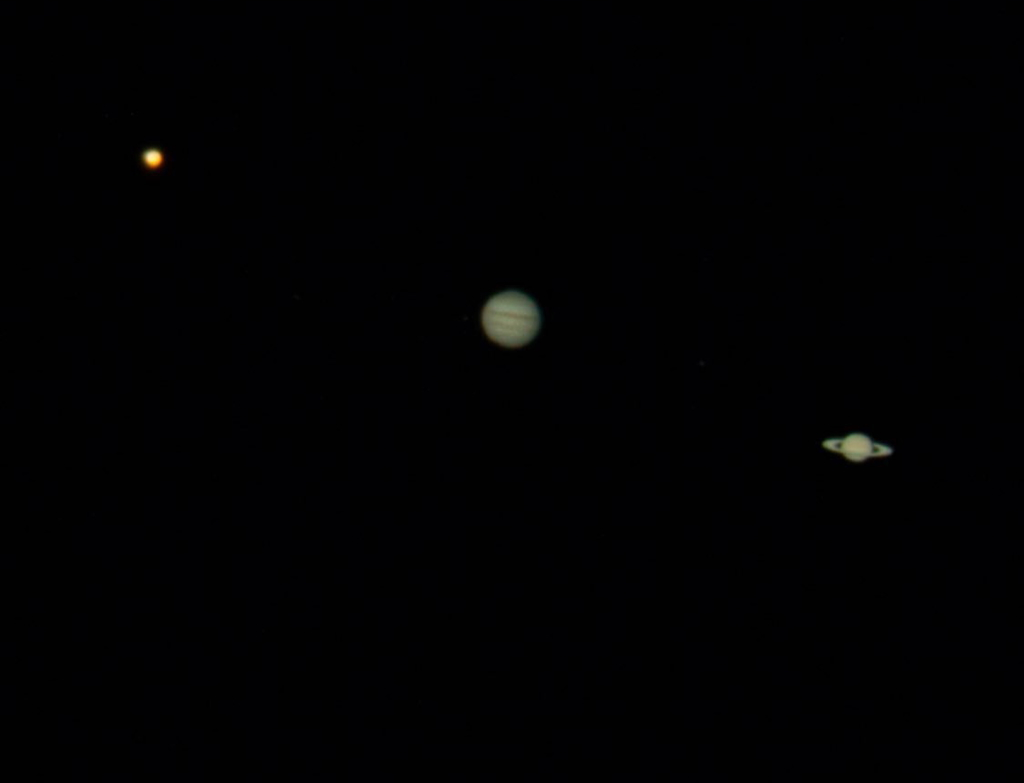
For example, the rings of Saturn are 45 arcseconds across at their widest point. The Cassini Division in Saturn’s rings spans approximately 0.7 to 0.8 arcseconds.
The shorthand you’ll see everywhere: degrees use the ° symbol, arc minutes use a single apostrophe (′), and arc seconds use a double apostrophe (″).
How to Measure the Sky With Your Hand
Here’s something you can actually use tonight, no equipment required.
Hold your arm out straight in front of you and use the system below to measure degrees.
- Your pinky finger covers roughly 1 degree of sky
- Three fingers held together cover roughly 5 degrees
- Your closed fist covers roughly 10 degrees
- Your full hand spread wide (pinky to thumb) covers roughly 20–25 degrees
These aren’t perfectly precise measurements, but they’re close enough to be useful.
How Big Are Things?
Here’s where it gets fun. Once you have this framework, objects stop being abstract and start having a real sense of scale.
The Moon and Sun — both sit at about 30 arc minutes (0.5°). This is why we get solar eclipses.
The Andromeda Galaxy (M31) — its full extent is actually around 3 degrees across. That’s six full Moons side by side. You’ll never see all of that in a single eyepiece view, and most of it is too faint to detect visually anyway, but the core and inner halo that you can see still span well over a degree.
The Orion Nebula (M42) — about 1 degree across at its widest. Wide enough that low-power eyepieces show it beautifully, with room to breathe.
The Pleiades — spans roughly 2 degrees. Perfect for binoculars, and a good sanity check for your hand measurement.
Jupiter at opposition — around 50 arc seconds. Tiny in the grand scheme, but enough to resolve cloud bands, the Great Red Spot, and the Galilean moons with modest aperture.
Mars — varies wildly depending on where it is in its orbit, from as small as 3.5 arc seconds (nearly useless for surface detail) to around 25 arc seconds at a close opposition. This is why opposition timing matters so much for planetary observers.
Double stars — separations are measured in arc seconds. Being able to split a double depends on your aperture, your seeing conditions, and how many arc seconds apart the pair actually is. A 1 arc second separation is a challenge even for a large telescope on a steady night. A 5 arc second split is comfortable for a modest 4-inch scope.

The 30-Degree Rule
This one is worth burning into your memory: try to observe objects that are more than 30 degrees above the horizon.
When an object low in the sky, you’re looking at it through a much thicker slice of atmosphere than when it’s overhead. That atmosphere blurs, dims, and distorts everything. Planets shimmer. Nebulae lose contrast. Stars that should be crisp look like they’re underwater.
Thirty degrees is roughly three fist-widths above the horizon and it’s a reliable cutoff for when the atmosphere stops working against you and starts becoming manageable.
Some experienced observers push it a little lower for bright objects, but as a beginner, respect the rule when you can. You’ll be amazed how much better even familiar targets look when they’re high enough.
Why This Actually Matters at the Eyepiece
Understanding angular measurement is the thing that ties a lot of astronomy knowledge together.
When you’re calculating the magnification you need to see a planet’s disc, you’re thinking in arc seconds. When you’re figuring out whether a deep sky object will fit in your eyepiece’s field of view, you’re comparing arc minutes. When you’re star hopping across the sky to find a faint galaxy, you’re counting degrees.
When you’re planning a session around a planet’s opposition, knowing that Mars will be 25 arc seconds wide versus 8 arc seconds wide tells you whether it’s even worth pulling out the telescope.
It also changes how you talk about what you’re seeing. Saying Jupiter is “big right now” is vague. Saying it’s sitting at 48 arc seconds and you’re running 200x magnification means something. It connects your experience at the eyepiece to the actual geometry of the solar system.
Once you start thinking in degrees, arc minutes, and arc seconds, you can set the right viewing expectations and navigate more efficiently in the night sky.
Get Started in Astronomy
If this has you fired up to get outside and start actually measuring what you’re looking at, the next step is making sure you have the right setup to do it well. Not sure where to start with equipment? I put together a free PDF telescope cheat sheet that covers which scope might be right for you, the specs that actually matter, and how to think through your budget before you buy. Grab it — it’ll give you a solid foundation before your first real night under dark skies.