This post contains affiliate links. As an Amazon Associate I earn from qualifying purchases. If you click a link and make a purchase, I may receive a small commission at no extra cost to you.
One of the most pressing questions every beginner faces is: what telescope should I actually get?
And the moment you start looking into it, you quickly realize this isn’t a simple question.
It opens up a whole conversation about the different types of telescopes out there — each with their own strengths, quirks, and passionate fan bases.
Here’s the quick breakdown:
Refractors are what most people picture when they think “telescope.” It’s a long tube with a lens at the front that bends light to a focal point. They’re great for planetary viewing and lunar work, require almost zero maintenance, and look beautiful. They’re also the ones people tend to buy, admire, and never use seriously.
Reflectors use mirrors instead of lenses. Light enters the tube, bounces off a curved primary mirror at the back, and gets redirected to an eyepiece on the side. Isaac Newton himself designed the first one.
Compound telescopes (like Schmidt-Cassegrains and Maksutov-Cassegrains) fold a long optical path into a compact tube using a combination of mirrors and lenses. They’re versatile and portable, but they’ll cost you.
As someone who has bought a variety of telescopes over the years, I’m here to tell you: as a beginner, go with a reflector. Here’s why.
The Deep Sky Objects Are Worth It Alone
Aperture is everything in astronomy, and getting serious aperture in a refractor costs serious money. A quality 4-inch refractor will run you several hundred dollars. A quality 6-inch? You’re deep into four-figure territory.
With a reflector, you can get a massive primary mirror for a fraction of that cost. And aperture is what lets you see. More light gathered means fainter objects, more detail, and more of the universe actually showing up in your eyepiece.
I’m talking about galaxies. Not just smudges but actual structure. The dust lanes of Andromeda. The arms of the Whirlpool Galaxy…. A reflector makes those moments accessible without bankrupting yourself to get there.

Collimation Is Not the Monster You Think It Is
I know what you’ve heard. Reflectors need collimation. It’s complicated. It’s a pain. And I won’t lie to you — there’s a learning curve.
But here’s my honest experience: I didn’t collimate my reflector until many months into owning it. And even then, I did it mostly out of curiosity. The first 15 minutes were pretty frustrating. But once I got my laser collimator figured out and understood what I was actually trying to accomplish, it became pretty straightforward to line everything up.
If you’re someone who takes care of your equipment (stores it properly, handles it with intention, doesn’t bang it around) you may find you rarely need to collimate at all.
It’s one of those things that sounds intimidating until you actually do it, and then you wonder what all the fuss was about.
There’s Just Something Different About Using One
Refractors are what most people think of when they picture a telescope. And maybe that’s the problem. They feel familiar, almost decorative. The kind of thing you see propped up in a living room corner or gathering dust in a closet.
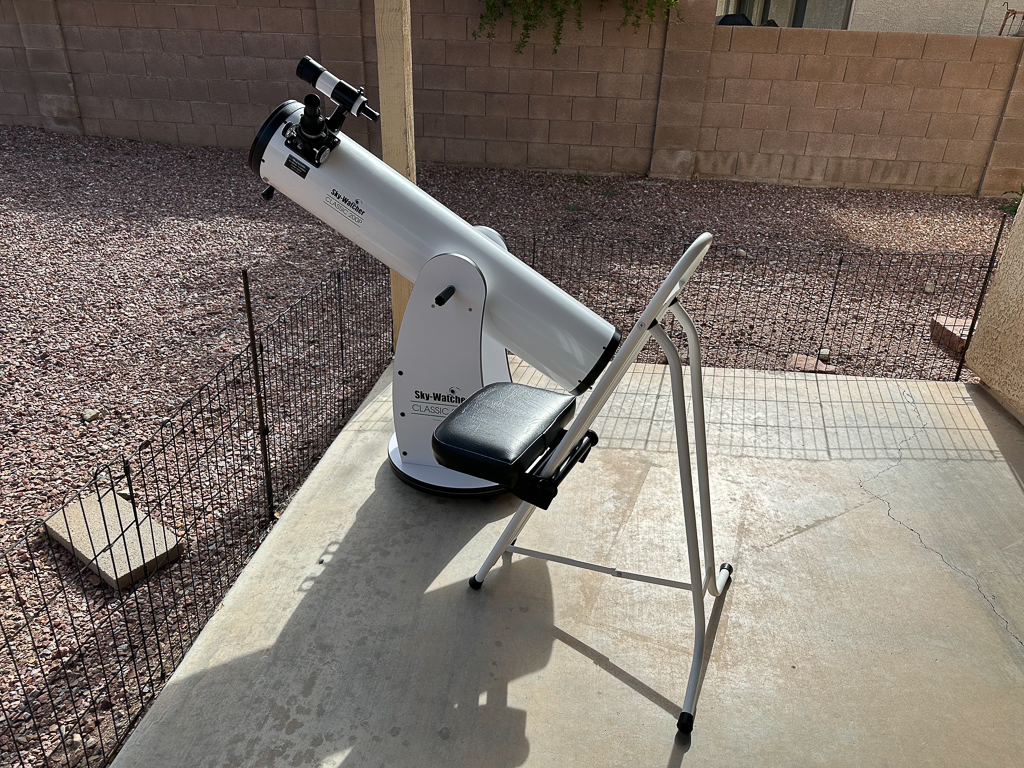
Getting a reflector, especially a Dobsonian, feels like a statement. It’s true, they are large and can occupy a lot of space, making it difficult from some people who don’t have easy access to a viewing area.
However, it feels like you’re actually venturing into astronomy, not just dipping a toe in.
I remember the first time I took mine outside to align my finder scope, pointing it toward some mountains near my home. Multiple people stopped to ask what I was doing. Someone said it looked like something from NASA.
If you’re looking to get something that will unequivocally remind you that you are an astronomer (or aspiring astronomer), you can’t beat a reflector telescope in my opinion.
It Was Isaac Newton’s Invention
Here’s a piece of history that adds to the experience of owning one of these things.
Isaac Newton didn’t invent the telescope — that credit goes to Hans Lippershey in 1608, with Galileo famously improving on it shortly after.
But Newton saw a fundamental problem with refractors: chromatic aberration, the way lenses split light into a rainbow of colors around the edges of objects. His solution was elegant. He decided to use a curved mirror instead of a lens to gather and focus light, completely bypassing the problem.
In 1668, Newton built the first working reflecting telescope. It was only 6 inches long and about 1.3 inches in aperture, but it worked. He presented it to the Royal Society in 1671, and it changed the trajectory of telescope design forever.
When you set up your Dobsonian in the backyard and start sweeping across the Milky Way, you’re using essentially the same principle Newton worked out over 350 years ago in his rooms at Trinity College, Cambridge.
That’s not a small thing. There’s a certain satisfaction in knowing that the tool in your hands traces a direct line back to one of the greatest scientific minds in history.
The Bottom Line
If you’re a beginner trying to decide where to put your money, put it in a reflector. You’ll get more aperture, more access to the deep sky, and a setup that feels genuinely like doing astronomy — not just dabbling in it. The learning curve is real but manageable, and what’s waiting for you on the other side of it is worth every minute.
The universe is big. Get yourself a telescope that can keep up with it.
Get Started in Astronomy
If this has you fired up to get out under a dark sky, the next step is making sure you have the right telescope in your hands when you get there. Not sure where to start? I put together a free PDF telescope cheat sheet that breaks down which scope might be right for you, the specs that actually matter, and how to figure out your budget before you buy anything. Grab it — it’ll save you a lot of second-guessing before your first real night out.