This post contains affiliate links. As an Amazon Associate I earn from qualifying purchases. If you click a link and make a purchase, I may receive a small commission at no extra cost to you.
A lot of people getting into astronomy immediately jump to thinking about a telescope.
There’s a certain romance to it. You picture yourself like Galileo in your backyard, eye pressed to the eyepiece, peering into the cosmos. Binoculars, on the other hand, feel a little boring by comparison. And let’s be honest, pulling them out in your backyard at midnight even looks a little creepy.
But binoculars are often a fantastic option not just for beginners, but for anyone serious about astronomy.
In this article, we’ll dig into exactly why they deserve so much more credit than they get, especially if you’re just starting out.
Binoculars Are a Natural Second Stepping Stone
There’s actually a logical progression to how many astronomers develop, and binoculars fit right in the middle of it.
It starts with naked-eye observation — learning the night sky, getting a feel for how brightness works, figuring out what your own eyes are capable of on a dark night.
From there, a pair of binoculars is the natural next step. They let you keep learning the sky while opening up a whole new level of detail: planets become more defined, massive deep-sky objects like the Orion Nebula and the Andromeda Galaxy come into view, and star clusters start to resolve in ways your naked eye simply can’t manage.
You also begin to develop an intuitive feel for core astronomy concepts like magnification and aperture. You’ll start to understand Bortle zones and how light pollution affects objects in your lenses, how dark adaptation works, and how to use averted vision — all fundamental skills that will serve you well when you eventually move to a telescope.
And that’s where the progression leads: eventually to a telescope that lets you push deeper into the sky and resolve finer detail in demanding objects. Everyone’s journey looks a little different, but this is a path a huge number of astronomers naturally follow — and it works.
Why Binoculars Are So Good for Beginners
They’re a Small Investment
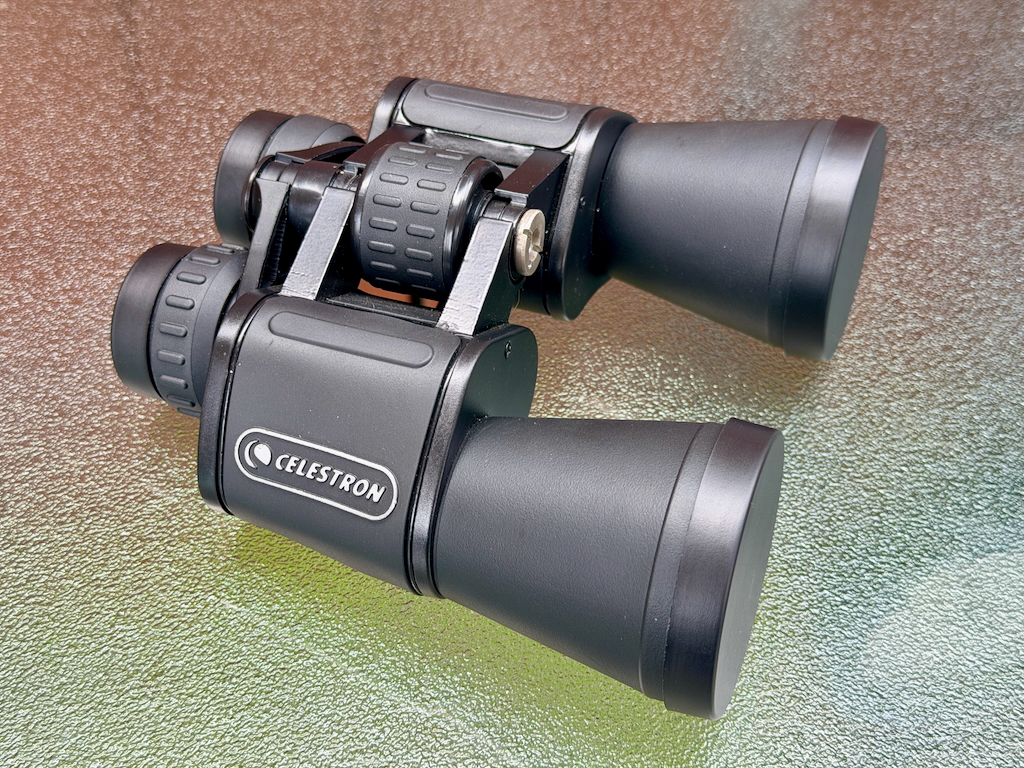
For around $40, you can get a decent beginner pair of binoculars.
There’s absolutely a difference between a $40 pair and a $300+ pair — the quality of the glass matters, and you will notice it. But brands like Celestron have made entry-level binoculars genuinely accessible, and even a budget pair will show you far more than your naked eye alone.
Compare that to telescopes, where you typically need to spend a few hundred dollars before you’re getting something really worth using. For a beginner who isn’t sure yet how deep they want to go, binoculars are a low-risk way to find out.
They’re Easy to Use
Telescopes can be frustrating, especially when you’re new.
Before you even get to look through one, you might be waiting an hour or more for the optics to cool down to ambient temperature. Then there’s collimation, the process of aligning your mirrors so the optical path is correct. Your finder scope needs to be aligned too. And if you have a computerized mount, you’re looking at an alignment routine before it’ll point at anything reliably. Any one of these steps can go wrong on a given night, and troubleshooting them in the dark with cold hands is nobody’s idea of a good time.
To be fair, once you know what you’re doing, the routine becomes second nature. But that learning curve is real, and it creates friction that discourages a lot of beginners from getting outside consistently.
With binoculars, none of that exists. You pick them up, you look through them, and you’re doing astronomy.
It is true most people don’t actually know the correct way to focus a pair of binoculars — there’s a right-eye diopter adjustment that most skip entirely — but once you learn the proper technique, you’re ready to go in seconds.
One of the most common reasons people abandon astronomy is that it simply feels like too much work to get outside and set up. Binoculars eliminate that friction almost entirely. They’re the option you’ll actually reach for on a random Tuesday night when the sky clears unexpectedly.
They’re Versatile
A telescope is generally built for one purpose. Binoculars go everywhere. A safari. A sports stadium. A hiking trail. A cruise ship deck at 2am. They pull double duty across your entire life in a way no telescope ever will, which means even if you step away from astronomy for a while, you haven’t wasted the money. They remain useful, they stay with you, and they’re right there when the itch to look up comes back.

Some Things Are Actually Better Through Binoculars
More magnification is not always better — this is one of the first things experienced astronomers learn, and binoculars make it obvious.
Large extended objects like the Andromeda Galaxy or the Pleiades are often more impressive through binoculars than through a telescope, because a telescope’s narrow field of view can actually clip the very things that make those objects stunning.
Higher-end binoculars will give you the most to appreciate here, but even a modest pair can deliver genuinely memorable views of the Moon’s craters, Jupiter’s moons, Saturn’s rings, and large open clusters.
There’s also something that often surprises new astronomers: binoculars give you a fundamentally different viewing experience because you’re using both eyes.
Your brain combines the signals from each eye into a single image that feels more natural and immersive, while also making faint objects and subtle contrast slightly easier to perceive. It doesn’t create a true 3D effect at astronomical distances, but two-eyed viewing is often more comfortable, less fatiguing, and simply more enjoyable than looking through a single eyepiece.
They Open the Door to “Big Binoculars”
Once you start down the binocular path, you’ll eventually discover that “big binoculars” are a thing. We’re talking 70mm aperture and above, with magnifications ranging from 15x up to 25x or higher.
Because of their size and weight, these require a dedicated mount or tripod, and they start to climb in price. Some people say at that point “you might as well just buy a telescope.” But that argument misses the point entirely.
Binocular astronomy is its own discipline. It has its own targets, its own techniques, and its own community. The wide-field, two-eyed experience of a large pair of mounted binoculars is genuinely different from what a telescope offers — not better or worse, just different.
If you travel frequently with your stargazing, or if you value having something fast and portable ready at a moment’s notice, a big binocular setup can be your primary instrument for years. Starting with a regular pair now puts you in a position to understand and appreciate that world later.
Which Binoculars Are Good for Beginners?
When it comes to astronomy, not all binoculars are created equal — and the differences come down to two numbers you’ll see on every pair.
Take a classic recommendation like 7×50 or 10×50. The first number is the magnification. A 7×50 makes everything appear seven times closer; a 10×50 brings it ten times closer.
The second number is the aperture — the diameter of each front lens in millimeters. At 50mm, you’re pulling in a solid amount of light, which is exactly what you need when you’re staring at faint objects in a dark sky.
For beginners, these two sizes are the most commonly recommended for good reason. The 7×50 is the classic choice — it has a wide field of view, the lower magnification makes it easier to hold steady by hand, and the large aperture gathers plenty of light. Think of it as the relaxed, wide-angle experience.
The 10×50 gives you a bit more reach and is still manageable handheld for most people, though you’ll notice more shake at higher magnifications. If your hands are steady or you plan to prop your elbows on something solid, it’s a great option.
Budget-friendly recommendations for beginners:
What you want to avoid as a beginner is chasing high magnification at the expense of everything else. A lot of cheap binoculars marketed as “powerful” will boast 20x or 25x magnification with a tiny aperture — that combination gives you a dim, shaky, narrow image that makes astronomy feel frustrating rather than rewarding. More power is not better if the glass and aperture can’t back it up.
The 50mm aperture is the sweet spot for a first pair. It’s large enough to gather meaningful light and show you real detail on the Moon, Jupiter’s moons, and deep-sky objects like the Orion Nebula — but not so large that the binoculars become heavy and awkward to use. Once you start going above 70mm, you’re entering big binocular territory and you’ll need a tripod to use them comfortably, which is a different conversation entirely.
For budget, brands like Celestron and Orion offer solid entry-level astronomy binoculars in the $40–$100 range. If you’re willing to spend more, you’ll notice a real improvement in optical clarity and the quality of the coatings on the glass — but even a modest pair in the right size will get you started properly.
The short version: grab a 7×50 or 10×50, stick to a reputable brand, and don’t let the marketing of high magnification distract you. Those two specs will serve you well for years.
Get Started in Astronomy
If this has you fired up to get out under a dark sky, the next step is making sure you have the right gear to bring with you. Not sure where to start? I put together a free PDF telescope cheat sheet that breaks down exactly which scope might be right for you, the specs that actually matter, and how to figure out your budget. Grab it — it’ll save you a lot of second-guessing before your first real dark sky night.