This post contains affiliate links. As an Amazon Associate I earn from qualifying purchases. If you click a link and make a purchase, I may receive a small commission at no extra cost to you.
Some celestial events happen once a decade. Some you have to travel for. Some require you to be in exactly the right place, on exactly the right night, with clear skies you’ve been praying for all week. Miss them and you wait years for another shot. This is the roller coaster ride of astronomy!
These are the five events I refuse to miss and why I think they’re so special.
Lunar Occultations
A lunar occultation is when a planet or star appears to slide behind the moon and it is one of the coolest things you will ever watch through a telescope.
I’ve captured a Mars occultation before, watching the red planet drift right up to the lunar edge and disappear behind it, and there’s just something about seeing two objects that massive appearing that close to each other that does something to you.
You suddenly feel like you are truly among the solar system. Not just looking up at it, but standing inside it, watching its colossal pieces move around each other in real time.

Oppositions
An opposition happens when Earth sits directly between the Sun and an outer planet, lining all three up in a row. The planet is closer to us than at any other point in that cycle, making it brighter and larger in the sky — the best viewing conditions you’ll get.
How good “best” actually is varies though. Orbits are ellipses, not perfect circles, so the Earth-planet distance at opposition shifts from one cycle to the next depending on where the planet is in its orbit.
A favorable opposition can put Mars close enough to appear up to seven times larger than at its worst — close enough that the reddish dot transforms into something with real detail worth studying: surface markings, polar ice caps, actual features emerging through the eyepiece.
These windows only come around every couple of years, so you have to stay on top of the calendar. When a favorable one is coming, you plan around it.
Meteor Showers
You never quite know what you’re going to get with a meteor shower, and that’s part of the appeal.
But if you’ve never sat under a genuinely active one (100–150 per hour) in a dark sky, you are missing something spectacular.
Ancient cultures saw meteor showers as messages from the gods, omens, souls crossing the sky — and while we now know they’re debris burning up in the atmosphere, watching one under a dark sky, you completely understand why people assigned them that kind of meaning. There’s something primal about it.
Fireballs in different colors streaking across the sky, sometimes in rapid succession. And when a shower is really peaking, the whole thing takes on this electric, almost unreal quality.
It’s one of those experiences that stays with you.

Aurora (Northern Lights)
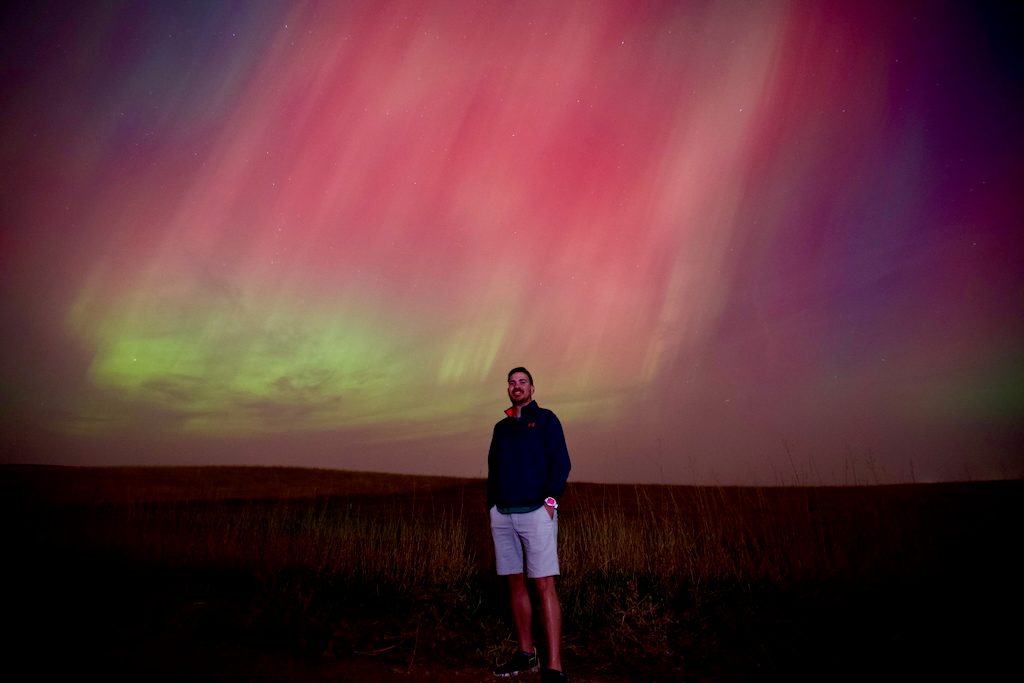
Chasing the aurora is a particular kind of thrill because you never know when they may happen and there’s usually a buildup of a few days of excitement and a lot of unknown.
You start tracking the forecasts days out, watching the reports on CMEs and the KP Index roll in, not really knowing what you’re going to get. X-class? M-class?
There are plenty of duds. Cloudy nights and smoke-filled skies. Times when everything just doesn’t cooperate. Sometimes Europe wins out, sometimes North America.
But when the conditions finally line up, the BZ drops, and you’re standing under a sky that’s actively dancing with color — greens, purples, reds — for hours on end, it’s an absolute spectacle.
Photographing it is just as addictive as watching it.
If the conditions call for, I’ll gladly drive several hours out for the chance to encounter a good solar storm. But first, I grab some Skittles, the seem to be the good luck charm.

Total Solar Eclipses
Seeing the northern lights is thrilling, but a total solar eclipse is something else entirely. It’s otherworldly in a way that’s hard to put into words until you’ve been there. It also feels oddly unifying.
And history backs that up. There’s a recorded account of a solar eclipse in 585 BC that literally stopped a battle mid-fight between the Lydians and the Medes — both armies were so shaken by the sudden darkness that they put down their weapons and negotiated peace on the spot. That’s the kind of power these things have over the human psyche.
During my first totality, everything dimmed, the temperature dropped, birds started acting strangely, and when I looked up, there was this perfect black circle hanging in the sky with a ring of light around it.
It’s a few minutes that feel completely outside of normal human experience. Like only this one single phenomenon in the sky matters at the moment. However cool or interesting you think it might be, I can promise you that it will be more than that, probably by a good margin.
Total solar eclipses are so rare that they are just on a different level of special. If there’s one event on this list you build a trip around, it’s this one.

Get Started in Astronomy
If this has you fired up to get out under a dark sky, the next step is making sure you have the right telescope to bring with you. Not sure where to start? I put together a free PDF telescope cheat sheet that breaks down exactly which scope might be right for you, the specs that actually matter, and how to figure out your budget. Grab it — it’ll save you a lot of second-guessing before your first real dark sky night.