This post contains affiliate links. As an Amazon Associate I earn from qualifying purchases. If you click a link and make a purchase, I may receive a small commission at no extra cost to you.
There are dark sky destinations, and then there are Easter Island dark sky destinations. Most of my dispatch spots will give you incredible skies. A handful will also give you a landscape that makes you feel like you’ve stepped out of time. Easter Island does both, and it does them at a level that is genuinely hard to wrap your head around until you’re standing there at midnight with the Milky Way pouring down over a row of ancient stone giants that have been staring at the horizon for 700 years. This one is special. Let’s get into it.
Overview
- Dark Sky Dispatch Location: Easter Island (Rapa Nui), Chile
- Bortle Class: 1–2
- IDA Designation: Not officially designated
- Population: ~7,750 (2017 Chilean census)
- Best Season: Year-round, though the dry season (May–October) brings the most reliably clear skies

What You’ll See
Stunning, ink-black skies backdropped by moai — some of the most striking and majestic compositions you’ll ever frame in a viewfinder or just drink in with your naked eye. For visitors from the Northern Hemisphere, this is also your golden ticket to experiencing the southern sky in a truly dark setting — and that alone is worth the journey.
During the day, you’ll be plenty occupied, checking out the different moai, volcanic coastline, lava tubes, and lots of other ancient artifacts.
Accessibility
Easter Island is one of the more logistically challenging destinations on this list. Expect extra connections, limited flights and a little extra paperwork. Once you’re there, much of the island sits under beautifully dark skies — but several of the key archaeological sites restrict access during dark hours, which can put real limits on your ability to observe or set up for astrophotography in key spots.
Field Notes
Stargazing on Easter Island is a full-on spectacle, and I don’t say that lightly. Depending on where you position yourself, you’re looking at Bortle 1 to 2 skies. The island’s only town, Hanga Roa, does produce a noticeable light dome on the southern end of the island — you’ll see it and feel it. But here’s the thing: just 15 minutes of driving gets you to the other side of the island, where you’re met with genuinely dark skies. There’s also some helpful topography out there that does a solid job blocking that glow from Hanga Roa, so don’t let that light dome discourage you.
This trip was my first time ever seeing the southern hemisphere sky from a truly dark location. Getting my eyes on the Magellanic Clouds — both Large and Small — was a bucket-list moment. They were sitting pretty low during my observing session, but I was absolutely thrilled to photograph them and actually just see them in person for the first time. I should mention there was a good amount of haze hugging the lower horizon, which did cut into the darkness a bit at those low altitudes, so just set that expectation going in.
Now, Easter Island also comes with some real challenges, and I want to be upfront about them.
Getting there is genuinely not easy. This is one of the most remote inhabited places on the planet — flights connect through Santiago, Chile, and you’re looking at a roughly five-hour leg just to cover that last stretch of Pacific Ocean. Plan accordingly.
Once you’re on the island, the access situation can be genuinely frustrating for stargazers and astrophotographers.
The historic sites operate under a tight access system — meaning you may simply not be allowed into some of the most iconic spots during the darkest hours of the night, when you’d want to be setting up your camera and letting your eyes fully dark-adapt. Shoreline spots should be accessible without much trouble, but if you’re dreaming of getting unobstructed time in front of the moai at 2am, know that it may not happen the way you’re picturing it.
I also had a rough experience with a tour guide that I want to share, not to complain, but because I think it points to something the island really needs to address. After waiting quite a while for one of the sites to open — long enough for our eyes to be well dark-adapted, 30-plus minutes — a tour guide leading a large group came in and essentially cut us in line, and then proceeded to shine bright white lights directly in our faces.
At a place with this level of dark sky prestige, that was genuinely hard to believe. No red lights. No awareness of adaptation time. And zero consideration for the other people around them who had been patiently waiting in the dark. This is a place that deserves better dark sky etiquette and, honestly, better education for the people leading visitors through it.
That said — we did manage to get into a couple of absolutely incredible experiences during the dark hours, and they made the whole trip.
Terevaka
The first was a hike up toward Terevaka, the island’s highest peak.
The trailhead for this was technically in one of the grounds only accessible during regular hours, but I spoke with a local who said that we could transit through without getting in trouble in order to get to the trailhead. He definitely ended up getting us in trouble in a different scenario later on, so I don’t know if it was actually okay for us to go through, but we did anyway, heading out probably around 3 AM.
We ended up having to turn around due to an incoming storm, but the hike itself was an adventure in the best and most chaotic sense. We were moving with only dim red lights to preserve our dark adaptation, and at one point a full stampede of horses charged through the darkness, close enough to make your heart stop.
A little later, a large dog I hadn’t heard coming rammed me from behind out of nowhere. So yes — animals are very much out and about at night on this island, and you should be mentally prepared for that. But hiking under a jaw-dropping Milky Way, even partially veiled by clouds, was something I’ll carry with me for a long time.
The coast
The second was the simplest. We found one of the coastal outcroppings and just set up there — no agenda, no guided access, no crowds. This was where I got my best extended look at the Magellanic Clouds. The haze I mentioned earlier does seem like it might just be a geographic reality of the island — something about the moisture sitting low over the ocean — so I didn’t get that crisp, all-the-way-to-the-horizon clarity that I always chase. But it was still deeply impressive, and in a lot of ways this kind of experience is exactly what dark sky travel is about: getting away from the light pollution, getting away from the tour groups, and just being alone with the sky.

Ahu Tongariki
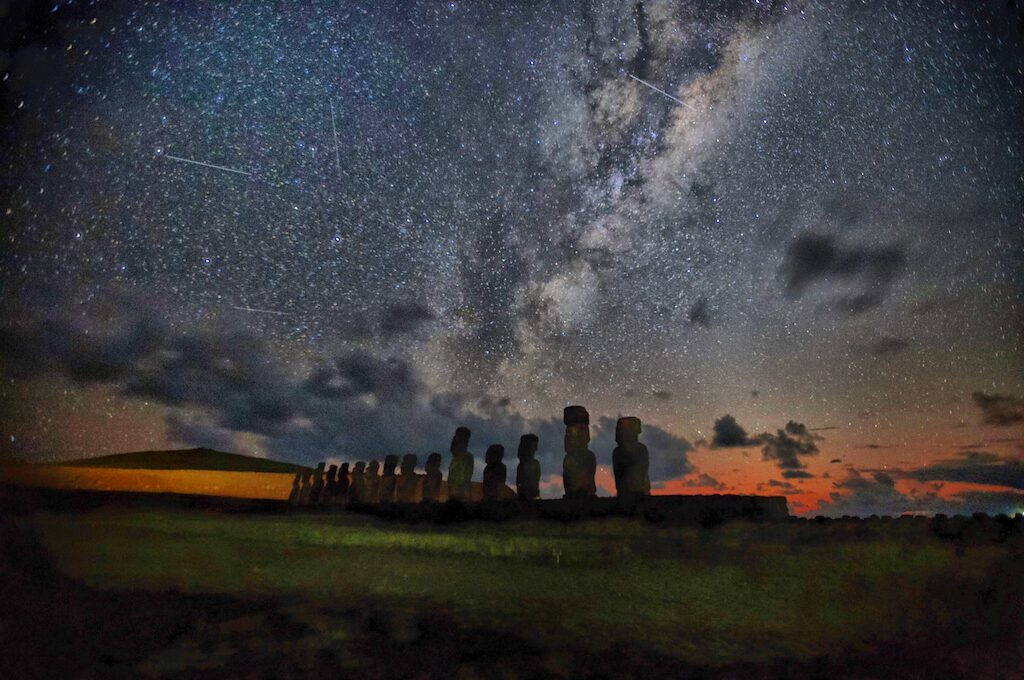
The third experience was at Ahu Tongariki — the largest ceremonial platform on the island and a place that’s typically known as the crown jewel spot for watching the sunrise. We accessed the site in the pre-dawn hours after our earlier run-in with that tour group, and even though I had to fight for it, I was able to get some shots I’m incredibly proud of — the Milky Way arching above those 15 standing moai is an image that doesn’t feel real when you’re standing in front of it.

And then, as the sky began to lighten toward sunrise, something I completely didn’t expect: I got my first ever clear view of Mercury. Just sitting there in the twilight glow. That one genuinely caught me off guard in the best way.
So here’s my honest bottom line: Easter Island is one of the most extraordinary places I’ve ever stargazed from, full stop. The darkness, the isolation, the site of ancient stone giants under the southern sky — it’s unlike anything else. Unforgettable. But the access limitations and the lack of dark sky awareness among some of the people running tours there are real friction points, and they deserve to be addressed. The island has something genuinely rare and remarkable here. It would be a shame not to protect and celebrate it properly.