This post contains affiliate links. As an Amazon Associate I earn from qualifying purchases. If you click a link and make a purchase, I may receive a small commission at no extra cost to you.
If you have spent any time reading about telescopes, you have probably seen the words Dobsonian and Newtonian used like they mean the same thing. They do not — but the confusion is understandable, and once you know the difference it all clicks into place pretty quickly.
The short answer is this: Newtonian describes the optical design inside the telescope, and Dobsonian describes the mount it sits on. They are two different things that happen to go together very often, which is why people blend the terms.
The Newtonian Part
A Newtonian telescope — named after Isaac Newton, who developed the design in the 1600s — is a type of reflector telescope. Instead of using lenses to gather light like a refractor does, it uses mirrors. Light enters the open top of the tube, travels down to a large concave primary mirror at the bottom, bounces back up and hits a smaller flat secondary mirror near the top, and then gets redirected out the side of the tube to your eyepiece.
It is an elegant and efficient design that has been around for centuries and remains one of the most popular optical systems in amateur astronomy — mainly because mirrors are cheaper to manufacture than high quality lenses, which means you can get a lot of light gathering ability for a relatively modest price.
The Dobsonian Part
The Dobsonian part has nothing to do with the optics. It refers entirely to the mount — the base that holds and moves the telescope.
The Dobsonian mount was developed by an amateur astronomer named John Dobson in the 1960s. His goal was simple: make a telescope that anyone could build cheaply and actually use without a physics degree. The mount he came up with is an altazimuth design, meaning it moves in just two directions — up and down, and left and right. Think of it like a camera on a swivel — you can point it anywhere in the sky with a simple push.
Compared to an equatorial mount, which has to be carefully aligned with the Earth’s rotational axis before you can use it, a Dobsonian mount is refreshingly straightforward. You pick it up, put it down, and start observing. There is no alignment process, no counterweights to balance, and no steep learning curve. You just point and look.
The base is typically a large rocker box — usually made of wood or particleboard — that sits directly on the ground and pivots smoothly in any direction. It is sturdy, stable, and surprisingly effective even at high magnifications.

Why People Use the Terms Interchangeably
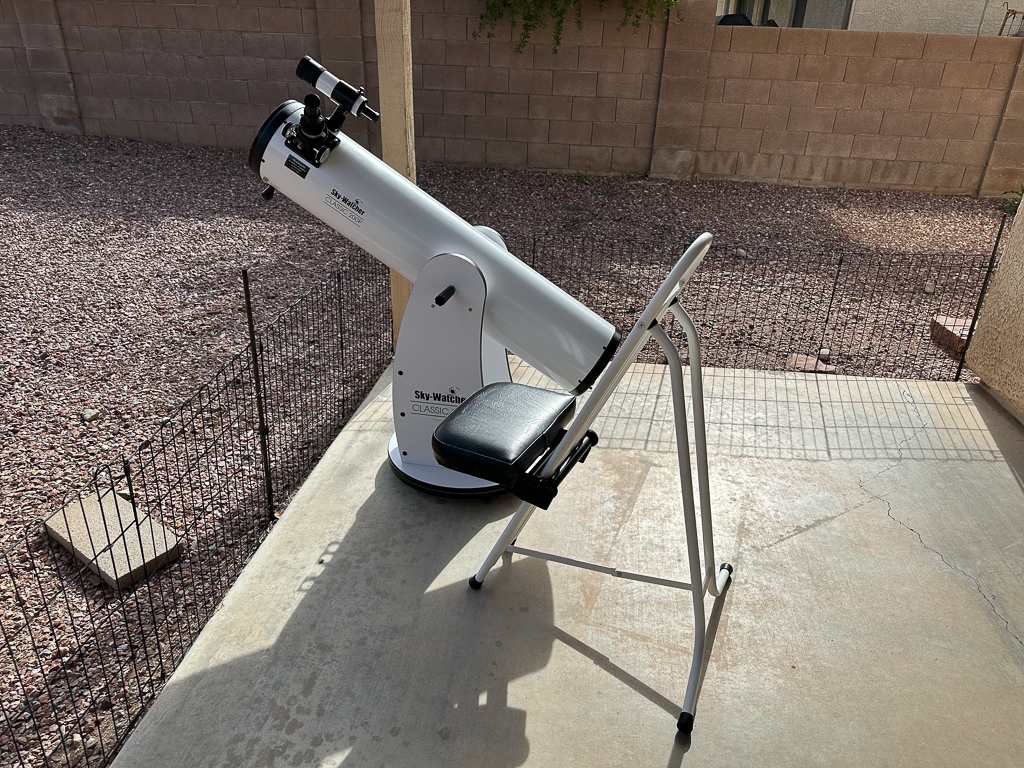
When someone says they have a Dobsonian, what they almost always mean is a Newtonian reflector telescope sitting on a Dobsonian mount. That combination is so common that the two words have essentially merged in casual conversation — the same way people say “Kleenex” when they mean any tissue.
So technically, calling it a Dobsonian is a bit like describing a car by its chassis rather than its engine. But in practice, when someone says Dobsonian, everyone in the hobby knows what they mean — a big reflector on a simple rocker base.
Pros and Cons
What makes a Dobsonian a great choice:
The biggest draw is aperture for the money. Because the mount is so simple and inexpensive to build, manufacturers can put the budget into a larger mirror instead. A Dobsonian will almost always give you more light gathering ability per dollar than any other telescope type. More aperture means fainter objects, more detail on planets, and better views across the board.
They are also genuinely easy to use. The altazimuth movement is intuitive in a way that an equatorial mount simply is not — especially when you are just starting out and do not want to spend your first night wrestling with setup instead of actually observing.
And the stability is underrated. That wide, low rocker base is remarkably solid. Vibrations settle quickly, which matters more than people realize when you are trying to hold a steady view at high magnification.
Where a Dobsonian has limitations:
The main tradeoff is size and weight. The larger the mirror, the bigger and heavier the whole setup becomes. A 10-inch Dobsonian is not something you casually toss in the trunk — it requires a bit of planning to transport and store.
Dobsonians are also not well suited to astrophotography. Because they use a simple altazimuth mount rather than a motorized equatorial one, they cannot accurately track the sky for the long exposures that deep sky imaging requires. If astrophotography is your primary goal, a Dobsonian is probably not your best starting point. For purely visual observing though, it is hard to beat.

Types of Dobsonian Mounts
Not all Dobsonians are identical. There are a few variations worth knowing about.
Classic Dobsonian
This is the original design — a solid tube reflector sitting in a wooden rocker box. It is simple, sturdy, and straightforward to put together even if you are not particularly handy. The azimuth bearing at the base rotates smoothly and the whole thing just works without much fuss. If you want the most telescope for your money with the least complexity, this is it.
Truss Tube Dobsonian
The truss tube design solves the portability problem that comes with larger Dobsonians. Instead of a solid tube, the upper section of the telescope is held together by a series of open poles — called trusses — that can be collapsed for transport and reassembled at the observing site. This makes a 12 or 14-inch telescope actually manageable to move around rather than a logistical challenge. The tradeoff is a slightly more involved setup process each session.

GoTo Dobsonian
This is a Dobsonian mount with a computerized motorized system added on. You align it to a couple of stars at the start of the session and from that point you can select any object from a database and the telescope will automatically slew to it and track it as the sky moves. It takes some of the navigation challenge out of the hobby, which some people appreciate — particularly beginners who want to spend their time looking rather than hunting.
The GoTo system does add cost and complexity, but it bridges the gap between the simplicity of a traditional Dobsonian and the tracking capability you would otherwise need an equatorial mount for.
The Bottom Line
A Dobsonian and a Newtonian are not the same thing, but they belong together. The Newtonian is the optical system doing the work, and the Dobsonian is the mount making it accessible. Together they form one of the best combinations in amateur astronomy — simple to use, affordable, and capable of genuinely impressive views of the night sky.
If you are a beginner trying to figure out what telescope to buy and you keep seeing Dobsonians recommended, now you know exactly why. A lot of aperture, not a lot of hassle.